Proceedings of the IEEE/CVF Conference on Computer Vision and Pattern Recognition Workshops (CVPRW 2022) · 2022
Adversarial Robustness Through the Lens of Convolutional Filters
Why this publication matters
Training a model to resist attacks changes the small visual patterns it learns to recognize. This paper makes those changes visible by comparing the filters inside robust and conventionally trained networks. Understanding those differences helps move robustness research from reporting scores toward explaining how the models work.
Abstract
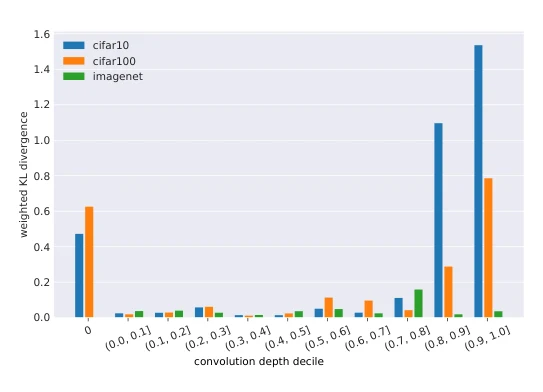
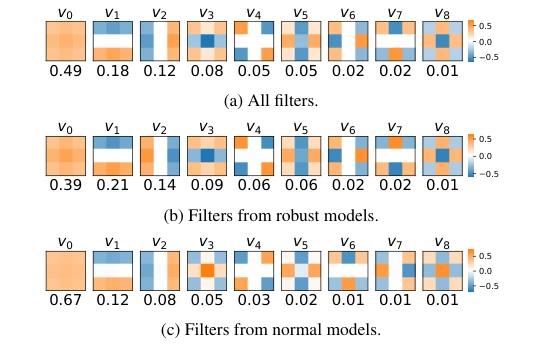
Deep learning models are intrinsically sensitive to distribution shifts in the input data. In particular, small, barely perceivable perturbations to the input data can force models to make wrong predictions with high confidence. An common defense mechanism is regularization through adversarial training which injects worst-case perturbations back into training to strengthen the decision boundaries, and to reduce overfitting. In this context, we perform an investigation of 3 × 3 convolution filters that form in adversariallytrained models. Filters are extracted from 71 public models of the l∞-RobustBench CIFAR-10/100 and ImageNet1k leaderboard and compared to filters extracted from models built on the same architectures but trained without robust regularization. We observe that adversarially-robust models appear to form more diverse, less sparse, and more orthogonal convolution filters than their normal counterparts. The largest differences between robust and normal models are found in the deepest layers, and the very first convolution layer, which consistently and predominantly forms filters that can partially eliminate perturbations, irrespective of the architecture. Data & Project website: https://github.com/paulgavrikov/cvpr22w_RobustnessThroughTheLens
Figures
Cite this paper
@inproceedings{gavrikov2022adversarialrobustnessthrough15,
  title = {{Adversarial Robustness Through the Lens of Convolutional Filters}},
  author = {Paul Gavrikov and Janis Keuper},
  booktitle = {Proceedings of the IEEE/CVF Conference on Computer Vision and Pattern Recognition Workshops (CVPRW 2022)},
  year = {2022},
  url = {https://openaccess.thecvf.com/content/CVPR2022W/ArtOfRobust/html/Gavrikov_Adversarial_Robustness_Through_the_Lens_of_Convolutional_Filters_CVPRW_2022_paper.html}
}
Figures and abstract are reproduced from the linked research sources. Credit remains with the authors and publishers.