The AAAI-22 Workshop on Adversarial Machine Learning and Beyond · 2022
Aliasing coincides with CNNs vulnerability towards adversarial attacks
Why this publication matters
Shrinking an image inside a neural network can introduce artifacts, much like jagged edges in a poorly resized photograph. This study connects those artifacts to sensitivity to carefully crafted image changes. It points researchers toward an everyday processing step that deserves attention when building more dependable vision systems.
Abstract
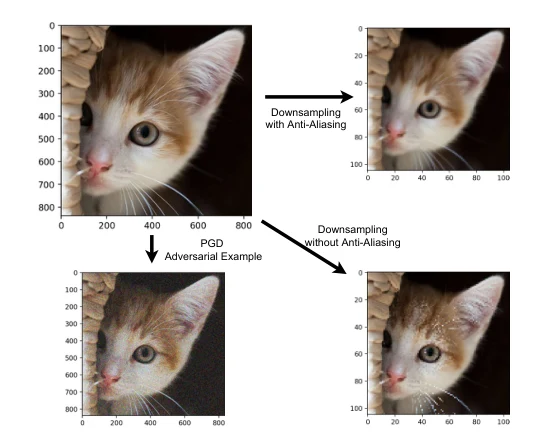
Many commonly well-performing convolutional neural network models have shown to be susceptible to input data perturbations, indicating a low model robustness. Adversarial attacks are thereby specifically optimized to reveal model weaknesses, by generating small, barely perceivable image perturbations that flip the model prediction. Robustness against attacks can be gained for example by using adversarial examples during training, which effectively reduces the measurable model attackability. In contrast, research on analyzing the source of a model’s vulnerability is scarce. In this paper, we analyze adversarially trained, robust models in the context of a specifically suspicious network operation, the downsampling layer, and provide evidence that robust models have learned to downsample more accurately and suffer significantly less from aliasing than baseline models.
Figures

Cite this paper
@inproceedings{grabinski2022aliasingcoincideswith9,
  title = {{Aliasing coincides with CNNs vulnerability towards adversarial attacks}},
  author = {Julia Grabinski and Janis Keuper and Margret Keuper},
  booktitle = {The AAAI-22 Workshop on Adversarial Machine Learning and Beyond},
  year = {2022},
  url = {https://openreview.net/pdf?id=vKc1mLxBebP}
}
Figures and abstract are reproduced from the linked research sources. Credit remains with the authors and publishers.