ECCV 2022 - Proceedings of the 17th European Conference, Tel Aviv, Israel · 2022
Learning Where To Look--Generative NAS is Surprisingly Efficient
Why this publication matters
Searching every possible neural network design is impractical. This method learns where promising designs are likely to be and concentrates the search there. It can consider both accuracy and the time a model takes to run, helping connect research performance to hardware constraints.
Abstract
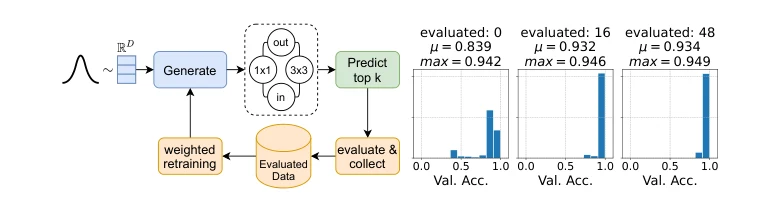
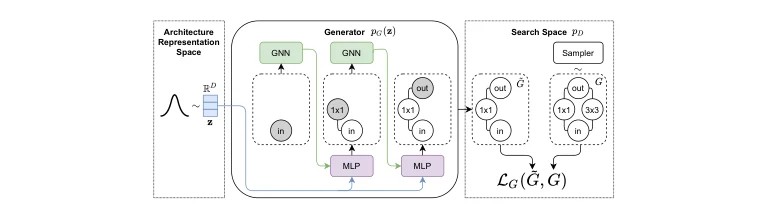
The efficient, automated search for well-performing neural architectures (NAS) has drawn increasing attention in the recent past. Thereby, the predominant research objective is to reduce the necessity of costly evaluations of neural architectures while efficiently exploring large search spaces. To this aim, surrogate models embed architectures in a latent space and predict their performance, while generative models for neural architectures enable optimization-based search within the latent space the generator draws from. Both, surrogate and generative models, have the aim of facilitating query-efficient search in a well-structured latent space. In this paper, we further improve the trade-off between query-efficiency and promising architecture generation by leveraging advantages from both, efficient surrogate models and generative design. To this end, we propose a generative model, paired with a surrogate predictor, that iteratively learns to generate samples from increasingly promising latent subspaces. This approach leads to very effective and efficient architecture search, while keeping the query amount low. In addition, our approach allows in a straightforward manner to jointly optimize for multiple objectives such as accuracy and hardware latency. We show the benefit of this approach not only w.r.t. the optimization of architectures for highest classification accuracy but also in the context of hardware constraints and outperform state-of-the-art methods on several NAS benchmarks for single and multiple objectives. We also achieve state-of-the-art performance on ImageNet. The code is available at https://github.com/jovitalukasik/AG-Net.
Figures
Cite this paper
@inproceedings{lukasik2022learningwhereto18,
  title = {{Learning Where To Look--Generative NAS is Surprisingly Efficient}},
  author = {Jovita Lukasik and Steffen Jung and Margret Keuper},
  booktitle = {European Conference on Computer Vision},
  year = {2022},
  url = {https://arxiv.org/pdf/2203.08734.pdf}
}
Figures and abstract are reproduced from the linked research sources. Credit remains with the authors and publishers.