Transactions on Machine Learning Research (TMLR) · 2024
As large as it gets-Studying Infinitely Large Convolutions via Neural Implicit Frequency Filters
Why this publication matters
Bigger image filters are often promoted as a way to improve neural networks, but how much of that extra space do models actually use? This work removes much of the cost barrier to studying very large filters. Its findings help distinguish useful spatial context from size that adds complexity without being fully used.
Abstract
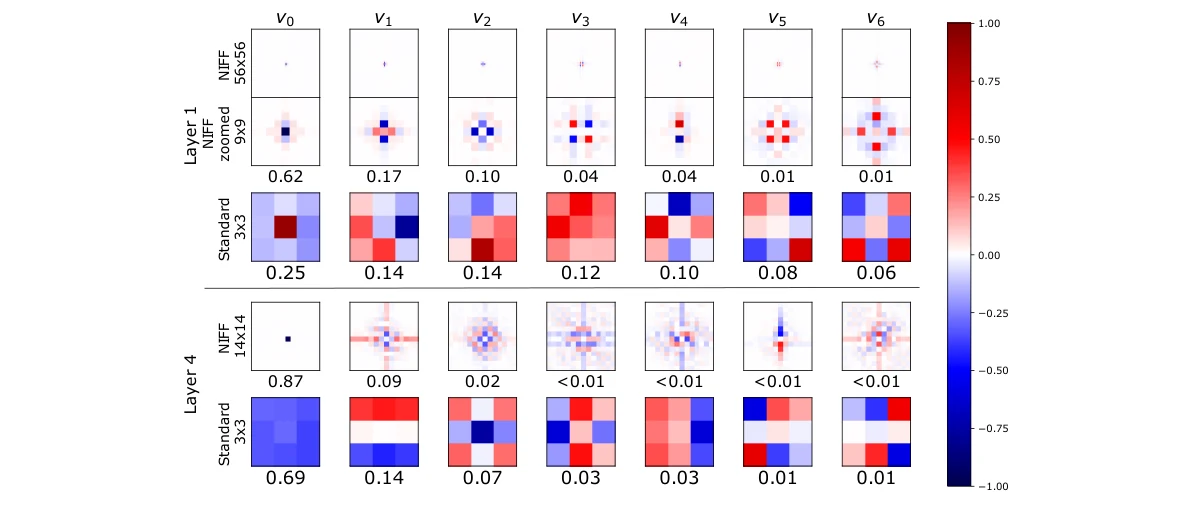
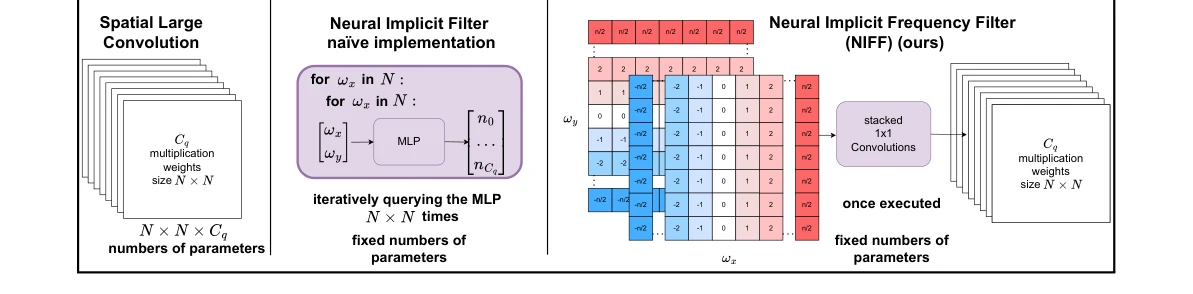
Recent work in neural networks for image classification has seen a strong tendency towards increasing the spatial context during encoding. Whether achieved through large convolution kernels or self-attention, models scale poorly with the increased spatial context, such that the improved model accuracy often comes at significant costs. In this paper, we propose a module for studying the effective filter size of convolutional neural networks (CNNs). To facilitate such a study, several challenges need to be addressed: (i) we need an effective means to train models with large filters (potentially as large as the input data) without increasing the number of learnable parameters, (ii) the employed convolution operation should be a plug-and-play module that can replace conventional convolutions in a CNN and allow for an efficient implementation in current frameworks, (iii) the study of filter sizes has to be decoupled from other aspects such as the network width or the number of learnable parameters, and (iv) the cost of the convolution operation itself has to remain manageable i.e. we can not naïvely increase the size of the convolution kernel. To address these challenges, we propose to learn the frequency representations of filter weights as neural implicit functions, such that the better scalability of the convolution in the frequency domain can be leveraged. Additionally, due to the implementation of the proposed neural implicit function, even large and expressive spatial filters can be parameterized by only a few learnable weights. Interestingly, our analysis shows that, although the proposed networks could learn very large convolution kernels, the learned filters are well localized and relatively small in practice when transformed from the frequency to the spatial domain. We anticipate that our analysis of individually optimized filter sizes will allow for more efficient, yet effective, models in the future. Our code is available at https://github.com/GeJulia/NIFF.
Figures
Cite this paper
@article{grabinski2024aslargeas47,
  title = {{As large as it gets-Studying Infinitely Large Convolutions via Neural Implicit Frequency Filters}},
  author = {Julia Grabinski and Janis Keuper and Margret Keuper},
  journal = {Transactions on Machine Learning Research},
  year = {2024},
  url = {https://arxiv.org/abs/2307.10001}
}
Figures and abstract are reproduced from the linked research sources. Credit remains with the authors and publishers.