
Proceedings of the IEEE/CVF Conference on Computer Vision and Pattern Recognition (CVPR 2024) · 2024
Can Biases in ImageNet Models Explain Generalization?
Why this publication matters
It is tempting to use one appealing property, such as a preference for shape, as a shortcut for judging model reliability. This study finds that those relationships depend on the models and tests being considered. It encourages direct, varied evaluation instead of assuming a single visual bias explains generalization.
Abstract
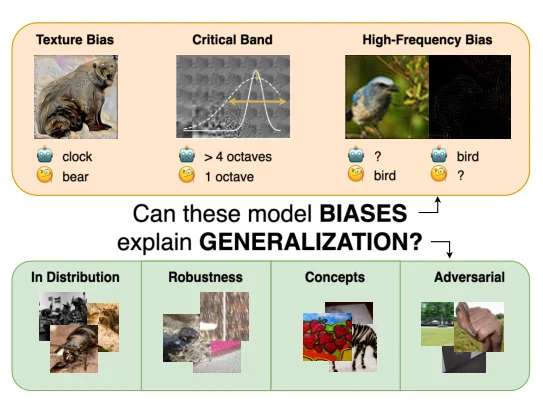
The robust generalization of models to rare, indistribution (ID) samples drawn from the long tail of the training distribution and to out-of-training-distribution (OOD) samples is one of the major challenges of current deep learning methods. For image classification, this manifests in the existence of adversarial attacks, the performance drops on distorted images, and a lack of generalization to concepts such as sketches. The current understanding of generalization in neural networks is very limited, but some biases that differentiate models from human vision have been identified and might be causing these limitations. Consequently, several attempts with varying success have been made to reduce these biases during training to improve generalization. We take a step back and sanitycheck these attempts. Fixing the architecture to the wellestablished ResNet-50, we perform a large-scale study on 48 ImageNet models obtained via different training methods to understand how and if these biases - including shape bias, spectral biases, and critical bands - interact with generalization. Our extensive study results reveal that contrary to previous findings, these biases are insufficient to accurately predict the generalization of a model holistically. We provide access to all checkpoints and evaluation code at https://github.com/paulgavrikov/biases_vs_generalization/
Figures

Cite this paper
@inproceedings{gavrikov2024canbiasesin44,
  title = {{Can Biases in ImageNet Models Explain Generalization?}},
  author = {Paul Gavrikov and Janis Keuper},
  booktitle = {Proceedings of the IEEE/CVF Conference on Computer Vision and Pattern Recognition (CVPR 2024)},
  year = {2024},
  url = {https://arxiv.org/pdf/2404.01509}
}
Figures and abstract are reproduced from the linked research sources. Credit remains with the authors and publishers.