
ICML 24 · 2024
CosPGD - an efficient white-box adversarial attack for pixel-wise prediction tasks
Why this publication matters
Systems that estimate motion or label every pixel need stress tests that go beyond ordinary image classification. CosPGD provides a shared way to construct challenging inputs across these tasks. It helps researchers compare reliability and uncover weaknesses that clean-image accuracy alone can conceal.
Abstract
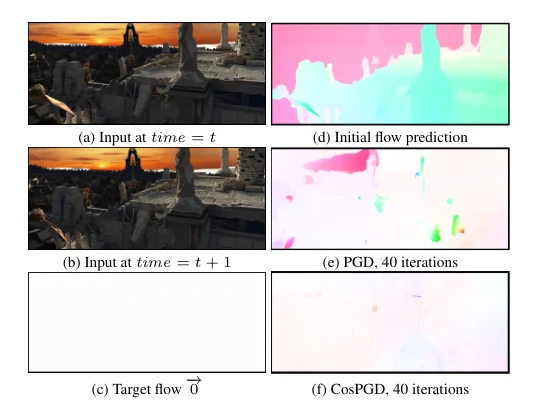
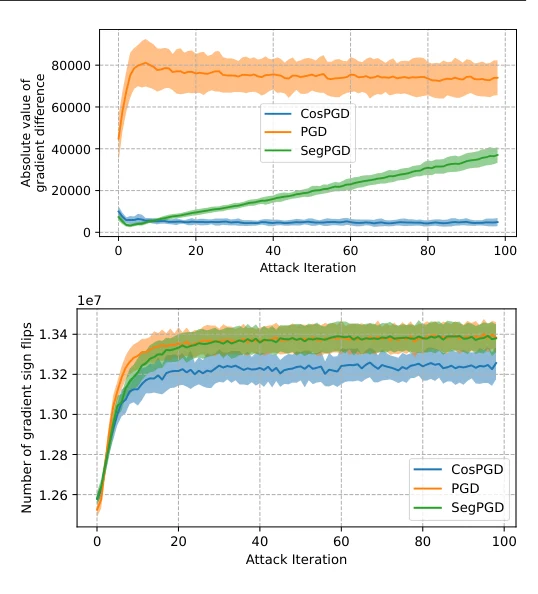
While neural networks allow highly accurate predictions in many tasks, their lack of robustness towards even slight input perturbations often hampers their deployment. Adversarial attacks such as the seminal projected gradient descent (PGD) offer an effective means to evaluate a model’s robustness and dedicated solutions have been proposed for attacks on semantic segmentation or optical flow estimation. While they attempt to increase the attack’s efficiency, a further objective is to balance its effect, so that it acts on the entire image domain instead of isolated pointwise predictions. This often comes at the cost of optimization stability and thus efficiency. Here, we propose CosPGD, an attack that encourages more balanced errors over the entire image domain while increasing the attack’s overall efficiency. To this end, CosPGD leverages a simple alignment score computed from any pixelwise prediction and its target to scale the loss in a smooth and fully differentiable way. It leads to efficient evaluations of a model’s robustness for semantic segmentation as well as regression models (such as optical flow, disparity estimation, or image restoration), and it allows it to outperform the previous SotA attack on semantic segmentation. We provide code for the CosPGD algorithm and example usage at https://github.com/shashankskagnihotri/cospgd.
Figures
Cite this paper
@inproceedings{agnihotri2024cospgdanefficient48,
  title = {{CosPGD - an efficient white-box adversarial attack for pixel-wise prediction tasks}},
  author = {Shashank Agnihotri and Stefen Jung and Margret Keuper},
  booktitle = {International Conference on Machine Learning},
  year = {2024},
  url = {https://openreview.net/forum?id=CXZqGJonmt}
}
Figures and abstract are reproduced from the linked research sources. Credit remains with the authors and publishers.