ICML 24 · 2024
MultiMax - Sparse and Multi-Modal Attention Learning
Why this publication matters
An attention mechanism needs to ignore irrelevant information without discarding several useful possibilities. MultiMax changes how attention weights are assigned to support both goals. Its evaluations show why this small mathematical component can matter across image and language tasks.
Abstract
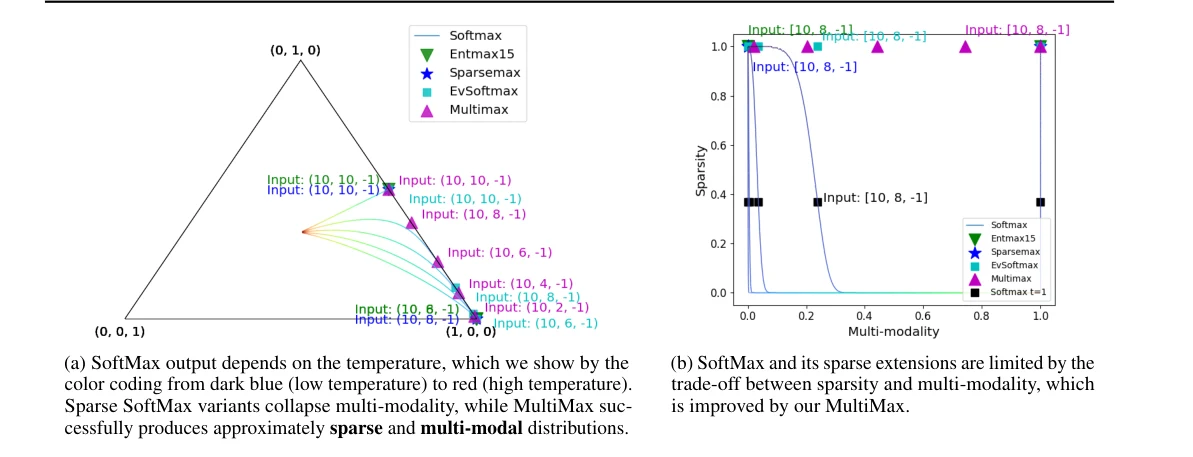
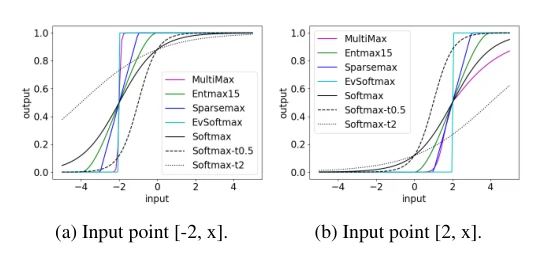
SoftMax is a ubiquitous ingredient of modern machine learning algorithms. It maps an input vector onto a probability simplex and reweights the input by concentrating the probability mass at large entries. Yet, as a smooth approximation to the Argmax function, a significant amount of probability mass is distributed to other, residual entries, leading to poor interpretability and noise. Although sparsity can be achieved by a family of SoftMax variants, they often require an alternative loss function and do not preserve multi-modality. We show that this trade-off between multi-modality and sparsity limits the expressivity of SoftMax as well as its variants. We provide a solution to this tension between objectives by proposing a piece-wise differentiable function, termed MultiMax, which adaptively modulates the output distribution according to input entry range. Through comprehensive analysis and evaluation, we show that MultiMax successfully produces a distribution that supresses irrelevant entries while preserving multimodality, with benefits in image classification, language modeling and machine translation. The code is available at https://github.com/ZhouYuxuanYX/MultiMax.
Figures
Cite this paper
@inproceedings{zhou2024multimaxsparseand49,
  title = {{MultiMax - Sparse and Multi-Modal Attention Learning}},
  author = {Y. Zhou and Mario Fritz and Margret Keuper},
  booktitle = {International Conference on Machine Learning},
  year = {2024},
  url = {https://openreview.net/forum?id=IC9UZ8lm25}
}
Figures and abstract are reproduced from the linked research sources. Credit remains with the authors and publishers.