
WACV 25 · 2025
FAIR-TAT - Improving Model Fairness Using Targeted Adversarial Training
Why this publication matters
A good average robustness score can hide poor performance on particular object categories. FAIR-TAT directs training toward reducing those differences. It brings the distribution of protection across classes into focus, rather than treating the overall average as the whole story.
Abstract
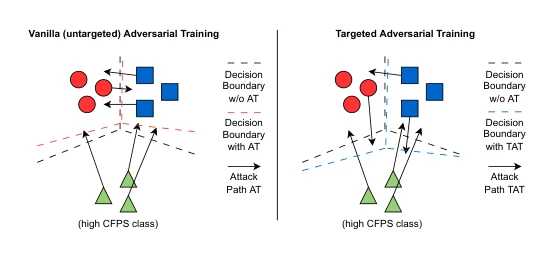
Deep neural networks are susceptible to adversarial attacks and common corruptions, which undermine their robustness. In order to enhance model resilience against such challenges, Adversarial Training (AT) has emerged as a prominent solution. Nevertheless, adversarial robustness is often attained at the expense of model fairness during AT, i.e., disparity in class-wise robustness of the model. While distinctive classes become more robust towards such adversaries, hard to detect classes suffer. Recently, research has focused on improving model fairness specifically for perturbed images, overlooking the accuracy of the most likely non-perturbed data. Additionally, despite their robustness against the adversaries encountered during model training, state-of-the-art adversarial trained models have difficulty maintaining robustness and fairness when confronted with diverse adversarial threats or common corruptions. In this work, we address the above concerns by introducing a novel approach called Fair Targeted Adversarial Training (FAIR-TAT). We show that using targeted adversarial attacks for adversarial training (instead of untargeted attacks) can allow for more favorable trade-offs with respect to adversarial fairness. Empirical results validate the efficacy of our approach.
Figures
Cite this paper
@inproceedings{medi2025fairtatimproving56,
  title = {{FAIR-TAT - Improving Model Fairness Using Targeted Adversarial Training}},
  author = {Tejaswini Medi and Steffen Jung and Margret Keuper},
  booktitle = {IEEE/CVF Winter Conference on Applications of Computer Vision},
  year = {2025},
  url = {https://arxiv.org/pdf/2410.23142}
}
Figures and abstract are reproduced from the linked research sources. Credit remains with the authors and publishers.