
IEEE Access, Volume 14, pp. 133004–133026 · 2026
LISP-Net: Context-Aware and Lightweight Interactive Medical Segmentation
Why this publication matters
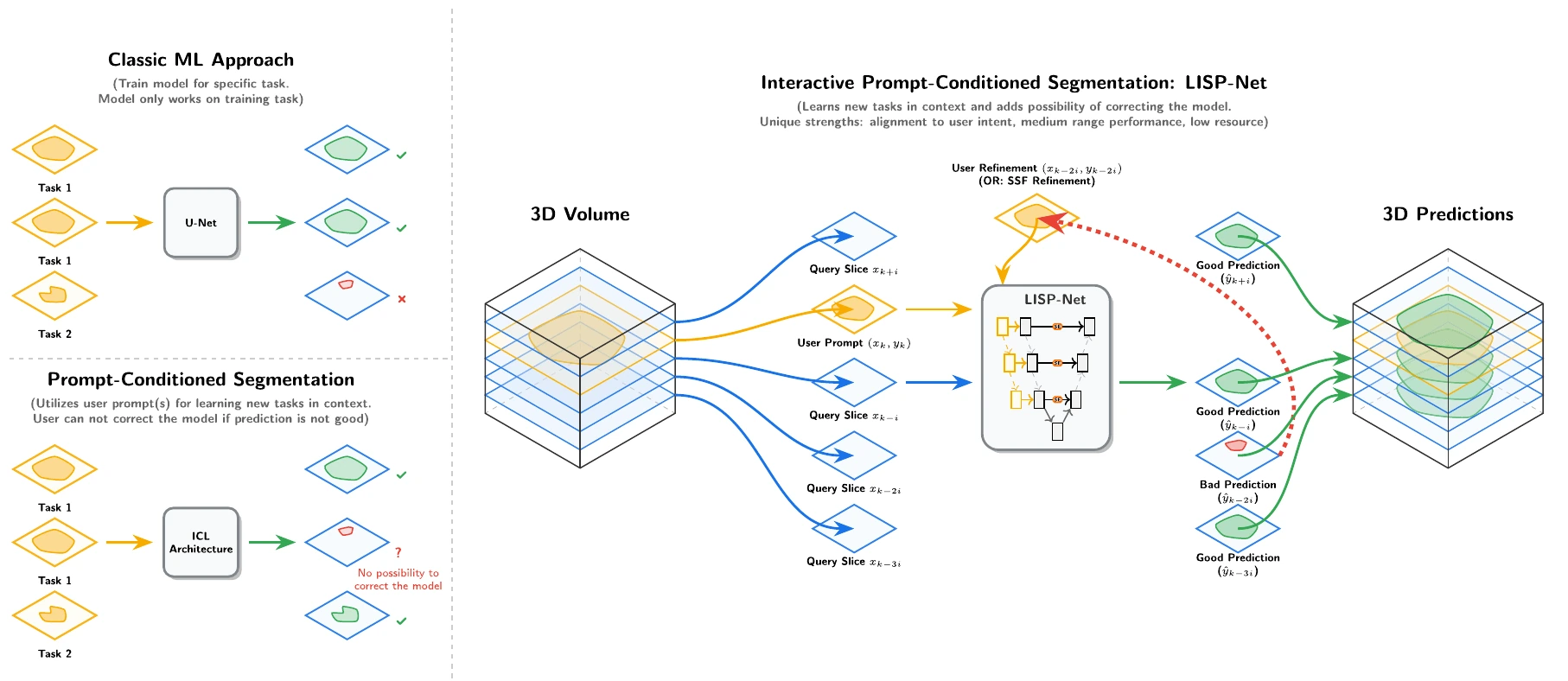
Medical image annotation needs models that can follow the user’s chosen boundaries across a scan without retraining for every new target. LISP-Net uses a densely labeled reference slice to guide nearby slices, with automatic feedback and optional user corrections to limit drift. Its compact convolutional design supports low-memory inference and a browser research prototype. The reported advantage over nnInteractive depends on simulated corrections using ground-truth masks; nnInteractive performs better when only one prompt is provided.
Abstract
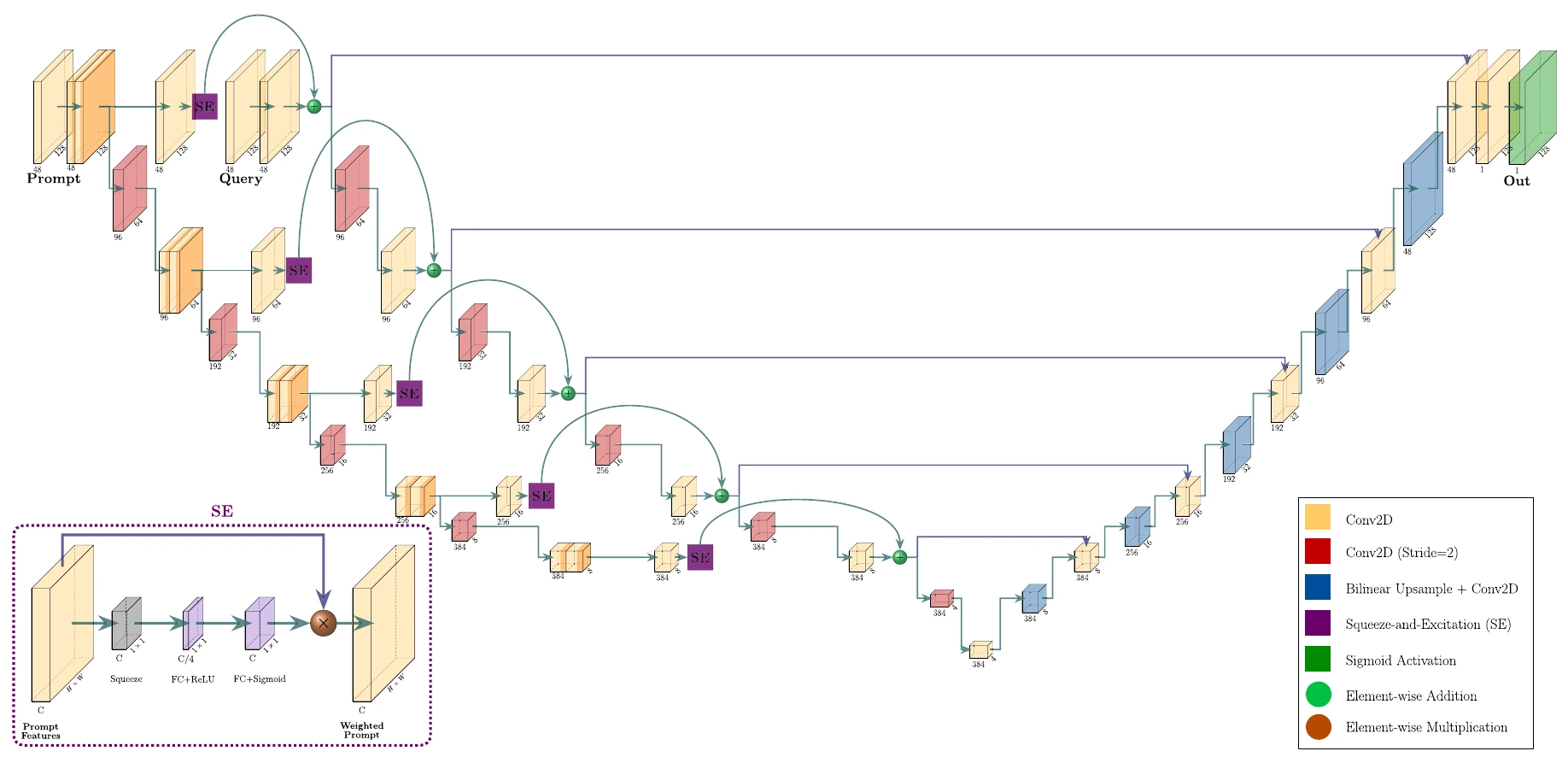
Precise medical image segmentation is essential to modern clinical workflows and biomedical research. However, current automated models often lack the flexibility, generalizability, and clinician control required to adapt to out-of-distribution data or novel classes without computationally expensive retraining. Furthermore, existing interactive segmentation tools are frequently computationally heavy and, relying on sparse cues that provide incomplete boundary and shape information, tend to default to learned anatomical priors rather than following the clinician’s visual intent. To address these limitations, we introduce LISP-Net (Lightweight In-Context Slice Propagator Network): a lightweight, purely convolutional framework for interactive volumetric medical image segmentation that uses a single dense 2D prompt to derive structural guidance from the individual patient. It features an asymmetrical dual-encoder dedicating most capacity to extracting structural and contrast semantics from the prompt while keeping the query pathway lightweight, and multi-resolution prompt conditioning via additive fusion at each encoder stage. An adaptive tiling strategy handles arbitrary resolutions, and a Self-monitoring Slice Feedback (SSF) mechanism mitigates structural drift during 3D propagation. Across 2D and 3D benchmarks, LISP-Net improved over UniverSeg by 23.73% at mid-range spatial offsets and over nnInteractive by 9.63% in volumetric Dice under simulated (oracle) interactive refinement, while nnInteractive led in the single-prompt setting (volumetric Dice 0.680 vs. 0.660). LISP-Net achieves these results with peak GPU memory of 164–780 MB and per-slice latency of approximately 14 ms on GPU and 150 ms on CPU. LISP-Net appears to show closer alignment with the user’s annotation intent rather than defaulting to learned anatomical priors, and a browser-based research prototype demonstrates the feasibility of client-side deployment.
Figures
Cite this paper
@ARTICLE{11666858,
  author = {Machauer, Paul and Reisert, Marco and Keuper, Janis},
  journal = {IEEE Access},
  title = {LISP-Net: Context-Aware and Lightweight Interactive Medical Segmentation},
  year = {2026},
  volume = {14},
  number = {},
  pages = {133004-133026},
  keywords = {Modeling;Dies;Training;Magnetic resonance imaging;Propagation;Tiles;Design methodology;Biomedical imaging;Liver;Computers;Convolutional neural networks;image segmentation;prompt-conditioned segmentation;interactive medical segmentation;volumetric propagation;zero-shot generalization},
  doi = {10.1109/ACCESS.2026.3727306}
}
Figures and abstract are reproduced from the linked research sources. Credit remains with the authors and publishers.