
BMVC 26 · 2026
Reinforcement Learning Based Fair Adversarial Training
Why this publication matters
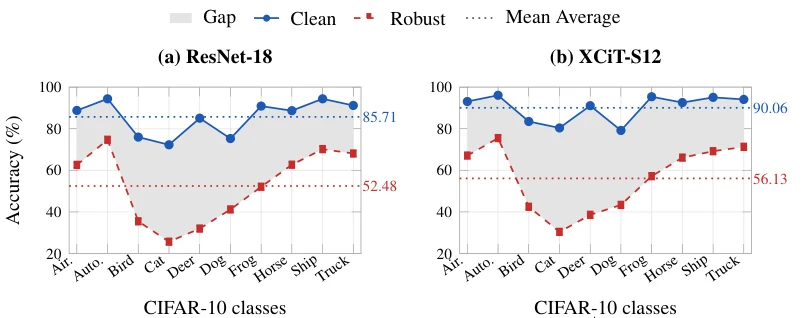
Training a model to resist attacks can protect some categories much better than others. RL-FAT uses feedback during training to respond to those differences. It aims to improve both overall robustness and the balance of protection across classes, making performance more informative than one average score.
Abstract
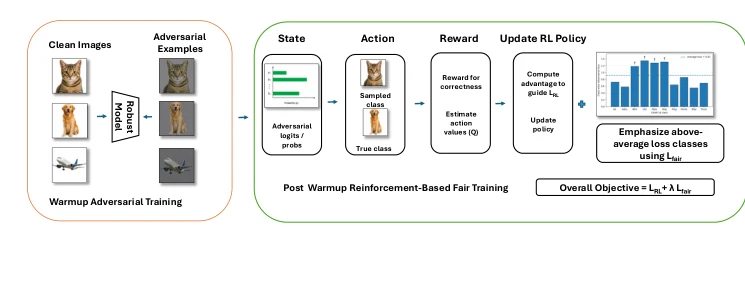
Deep neural networks remain highly vulnerable to adversarial perturbations, and adversarial training (AT) has become a widely used approach for improving robustness. However, improvements in average robust accuracy often mask substantial class-wise disparities: while some classes become more robust, others may remain disproportionately vulnerable under attack. This imbalance raises an important adversarial fairness concern, particularly in vision tasks where reliable robustness is expected across all categories. To address this challenge, we propose RL-FAT, a reinforcement-learninginspired fair adversarial training framework that uses policy-gradient based feedback from adversarial predictions. RL-FAT interprets the prediction distribution as a policy and combines correctness-based prediction rewards with class-wise value estimates to compute class-specific advantages for policy-gradient optimization. This enables the model to adaptively focus on class-wise misclassification. Furthermore, we introduce a fairness-emphasis adversarial loss that assigns stronger training pressure to classes with high adversarial loss, thereby mitigating class-wise robustness disparity. By combining reinforcement-driven adaptation with fairness-emphasis regularization, RL-FAT improves adversarial robustness while promoting a more balanced robustness distribution across classes. Extensive experiments demonstrate that our method achieves competitive robust accuracy and substantially reduces class-wise robustness imbalance compared with standard adversarial training baselines.
Figures
Cite this paper
@inproceedings{medi2026reinforcementlearningbased100,
  title = {{Reinforcement Learning Based Fair Adversarial Training}},
  author = {Tejaswini Medi and Levan Mikeladze and Margret Keuper},
  booktitle = {British Machine Vision Conference},
  year = {2026},
  url = {https://arxiv.org/abs/2608.29247}
}
Figures and abstract are reproduced from the linked research sources. Credit remains with the authors and publishers.