Proceedings of the IEEE/CVF Conference on Computer Vision and Pattern Recognition (CVPR 2020) · 2020
Watch your Up-Convolution - CNN Based Generative Deep Neural Networks are Failing to Reproduce Spectral Distributions
Why this publication matters
An AI-generated photograph can look convincing while still containing patterns that a person would never notice. This paper identifies how common image-building steps create those patterns and shows how to reduce them. The finding helps explain both why some fake-image detectors work and how to build more faithful image generators.
Abstract
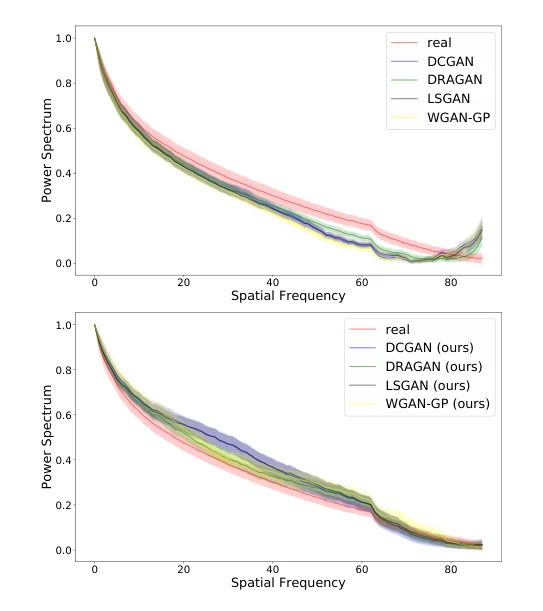
Generative convolutional deep neural networks, e.g. popular GAN architectures, are relying on convolution based up-sampling methods to produce non-scalar outputs like images or video sequences. In this paper, we show that common up-sampling methods, i.e. known as upconvolution or transposed convolution, are causing the inability of such models to reproduce spectral distributions of natural training data correctly. This effect is independent of the underlying architecture and we show that it can be used to easily detect generated data like deepfakes with up to 100% accuracy on public benchmarks. To overcome this drawback of current generative models, we propose to add a novel spectral regularization term to the training optimization objective. We show that this approach not only allows to train spectral consistent GANs that are avoiding high frequency errors. Also, we show that a correct approximation of the frequency spectrum has positive effects on the training stability and output quality of generative networks.
Figures
Cite this paper
@inproceedings{durall2020watchyourup1,
  title = {{Watch your Up-Convolution - CNN Based Generative Deep Neural Networks are Failing to Reproduce Spectral Distributions}},
  author = {Ricard Durall and Margret Keuper and Janis Keuper},
  booktitle = {Proceedings of the IEEE/CVF Conference on Computer Vision and Pattern Recognition (CVPR 2020)},
  year = {2020},
  url = {https://openaccess.thecvf.com/content_CVPR_2020/papers/Durall_Watch_Your_Up-Convolution_CNN_Based_Generative_Deep_Neural_Networks_Are_CVPR_2020_paper.pdf}
}
Figures and abstract are reproduced from the linked research sources. Credit remains with the authors and publishers.