
AI for Multimedia Forensics & Disinformation Detection Workshop at ECCV 26 · 2026
LAION-Mobile - Evaluating Deepfake Detectors On One Million Smartphone Photos
Why this publication matters
A deepfake detector should not label ordinary smartphone photographs as fabricated simply because their processing differs from its training data. LAION-Mobile tests that problem with roughly a million photos and camera metadata. It reveals how benchmark success can hide serious problems with real photographs and decision thresholds.
Abstract
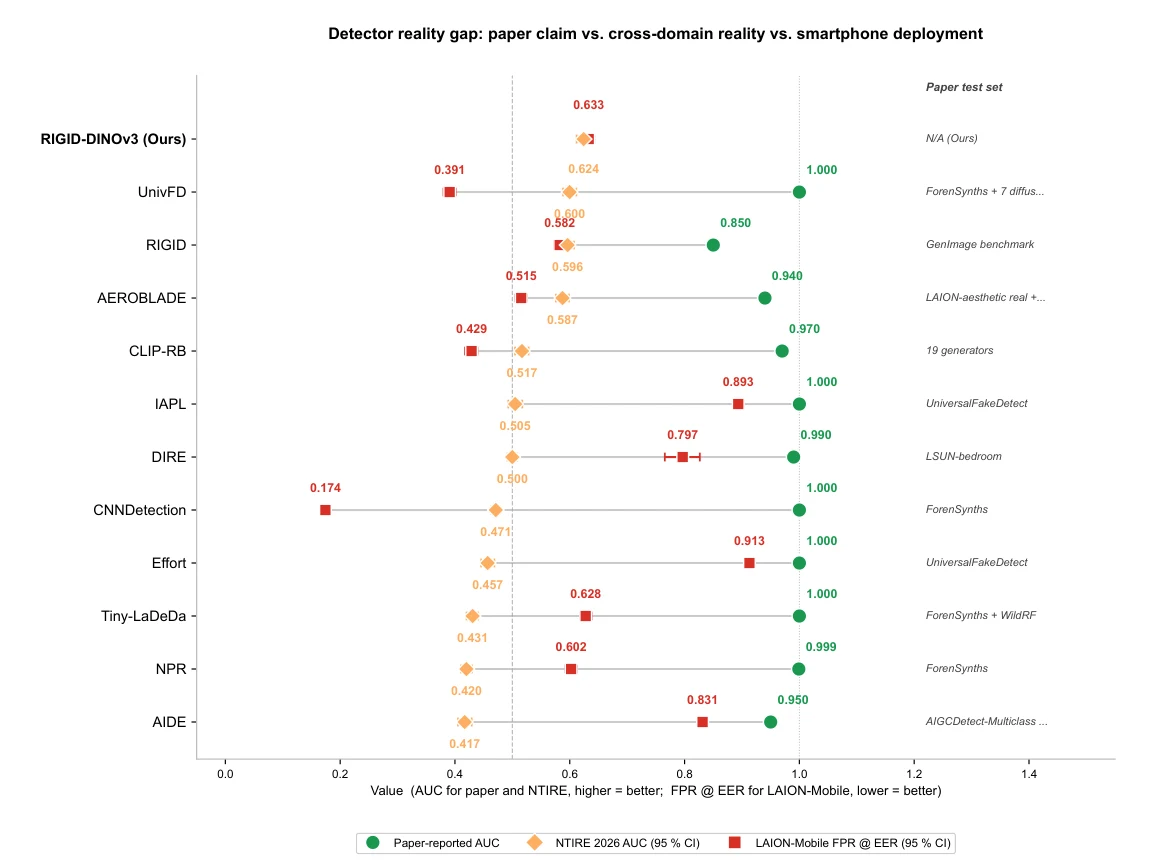
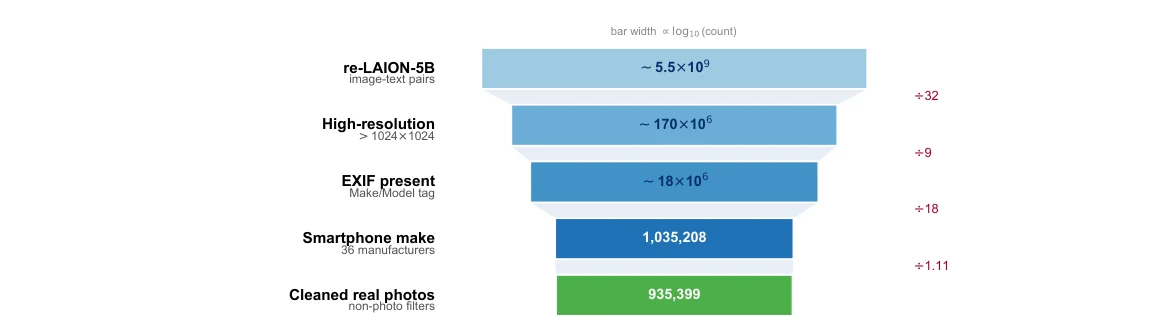
Most Deepfake detectors report near-perfect AUC scores on their reference benchmarks. However, a recent ICML position paper argues that these evaluations collectively neglect the impact of modern smartphone photography: the widely used on-device neural image-signal processing pipelines (like multi-sensor fusion or noise and motion-blur suppression) increasingly shift the imaging paradigm from simple lens projections towards computational photography. Hence, devices actually generate, rather than record photos. This increases the risk that deepfake detectors may flag ordinary phone photos as fake. Due to the lack of large-scale datasets containing images from modern smartphones, this hypothesis has so far only been tested in small proof-ofconcept studies. The aim of this paper is to close this gap. We introduce “LAION-Mobile”, an open dataset containing ∼1 million smartphone images with EXIF metadata distilled from re-LAION-5B. Evaluating twelve state-of-the-art deepfake detectors with their original paper checkpoints on a 9,115-image evaluation sample of this pool (DIRE on 738), we report three key findings: (i) On modern AI content no detector exceeds AUC 0.624, and five of twelve fall below chance. (ii) Realphoto false-alarm rates are an artefact of threshold calibration: thresholds fitted on legacy GAN data make several detectors look deployable (≤11% FPR), yet the same detectors flag 17–91% of real photos once the identical criterion is refit on modern content. (iii) Consequently, no detector both beats chance on modern AI content and keeps a deployable real-photo false-alarm rate. Mirroring the device mix of web collections, the corpus probes the first neural-ISP generation (2018–2020); current flagships are essentially absent, leaving the modern-ISP regime as the open gap. The “LAION-Mobile” dataset, including per-image EXIF metadata is available at https://huggingface.co/datasets/laionmobile/laion-mobile.
Figures
Cite this paper
@inproceedings{stryk2026laionmobileevaluating98,
  title = {{LAION-Mobile - Evaluating Deepfake Detectors On One Million Smartphone Photos}},
  author = {Achim von Stryk and Janis Keuper},
  booktitle = {AI for Multimedia Forensics \& Disinformation Detection Workshop at ECCV 26},
  year = {2026},
  url = {https://openreview.net/pdf?id=nKXIRrwFYp}
}
Figures and abstract are reproduced from the linked research sources. Credit remains with the authors and publishers.