
NeurIPS 21, proceedings of the thirty-sixth Conference on Neural Information Processing Systems · 2021
Shape your Space - A Gaussian Mixture Regularization Approach to Deterministic Autoencoders
Why this publication matters
An image generator first needs a useful way to organize what it has learned. This paper gives that internal representation room for several distinct groups instead of forcing everything into one simple pattern. The result is a more flexible generator that can be trained without a separate step to fit its internal data distribution.
Abstract
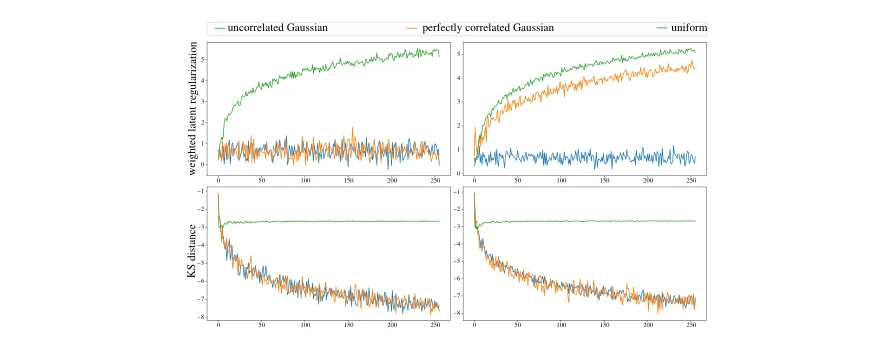
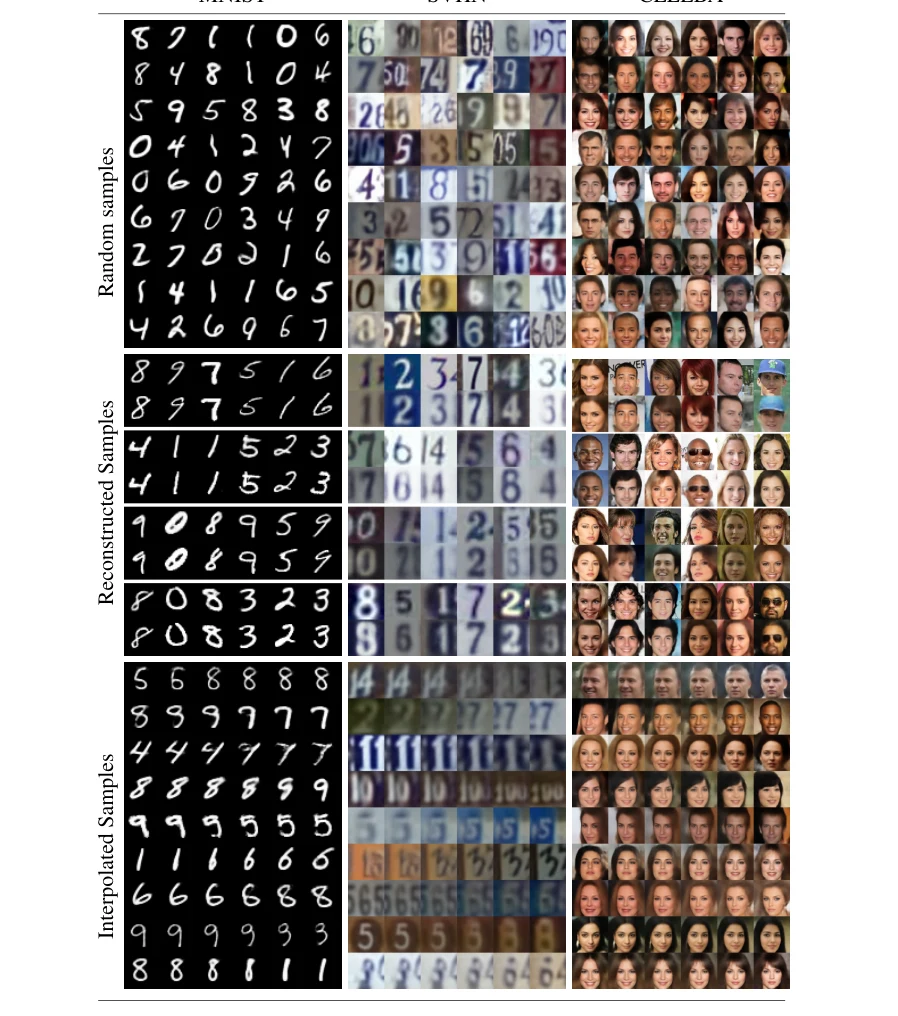
Variational Autoencoders (VAEs) are powerful probabilistic models to learn representations of complex data distributions. One important limitation of VAEs is the strong prior assumption that latent representations learned by the model follow a simple uni-modal Gaussian distribution. Further, the variational training procedure poses considerable practical challenges. Recently proposed regularized autoencoders offer a deterministic autoencoding framework, that simplifies the original VAE objective and is significantly easier to train. Since these models only provide weak control over the learned latent distribution, they require an ex-post density estimation step to generate samples comparable to those of VAEs. In this paper, we propose a simple and end-to-end trainable deterministic autoencoding framework, that efficiently shapes the latent space of the model during training and utilizes the capacity of expressive multi-modal latent distributions. The proposed training procedure provides direct evidence if the latent distribution adequately captures complex aspects of the encoded data. We show in experiments the expressiveness and sample quality of our model in various challenging continuous and discrete domains. An implementation is available at https://github.com/boschresearch/GMM_DAE.
Figures
Cite this paper
@inproceedings{saseendran2021shapeyourspace5,
  title = {{Shape your Space - A Gaussian Mixture Regularization Approach to Deterministic Autoencoders}},
  author = {Amrutha Saseendran and Kathrin Skubch and Stefan Falkner and Margret Keuper},
  booktitle = {Advances in Neural Information Processing Systems},
  year = {2021},
  url = {https://proceedings.neurips.cc/paper/2021/file/3c057cb2b41f22c0e740974d7a428918-Paper.pdf}
}
Figures and abstract are reproduced from the linked research sources. Credit remains with the authors and publishers.