
Proceedings of the IEEE/CVF Conference on Computer Vision and Pattern Recognition Workshops (CVPRW 2023) · 2023
Intra-Source Style Augmentation for Improved Domain Generalization
Why this publication matters
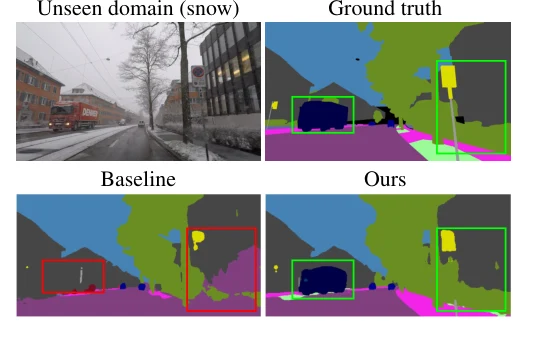
A system trained to understand sunny street scenes may struggle when it snows. This method changes the appearance of training images while preserving what is in the scene. That supplies useful visual variety without requiring new annotations for every weather condition or style.
Abstract
The generalization with respect to domain shifts, as they frequently appear in applications such as autonomous driving, is one of the remaining big challenges for deep learning models. Therefore, we propose an intra-source style augmentation (ISSA) method to improve domain generalization in semantic segmentation. Our method is based on a novel masked noise encoder for StyleGAN2 inversion. The model learns to faithfully reconstruct the image, preserving its semantic layout through noise prediction. Random masking of the estimated noise enables the style mixing capability of our model, i.e. it allows to alter the global appearance without affecting the semantic layout of an image. Using the proposed masked noise encoder to randomize style and content combinations in the training set, ISSA effectively increases the diversity of training data and reduces spurious correlation. As a result, we achieve up to 11.3% mIoU improvements on driving-scene semantic segmentation under domain shifts, e.g., adverse weather conditions.
Figures
![Qualitative results (best view in color and zoom in) of StyleGAN2 inversion methods on Cityscapes, i.e., pSp†, Feature-Style encoder [26] and our masked noise encoder.](/images/publications/details/030-figure-2.webp)
Cite this paper
@inproceedings{li2023intrasourcestyle30,
  title = {{Intra-Source Style Augmentation for Improved Domain Generalization}},
  author = {Yumeng Li and Dan Zhang and Margret Keuper and Anna Khoreva},
  booktitle = {Proceedings of the IEEE/CVF Conference on Computer Vision and Pattern Recognition Workshops (CVPRW 2023)},
  year = {2023},
  url = {https://generative-vision.github.io/workshop-CVPR-23/data/12.pdf}
}
Figures and abstract are reproduced from the linked research sources. Credit remains with the authors and publishers.