Proceedings of the Nineth International Conference on Learning Representations ( 24) · 2024
Adversarial Supervision Makes Layout-to-Image Diffusion Models Thrive
Why this publication matters
An image generator should put objects where a supplied layout says they belong, while still allowing the scene's appearance to change. This work improves that balance through additional training feedback. The resulting images can also diversify training data for systems that need to understand unfamiliar scenes.
Abstract
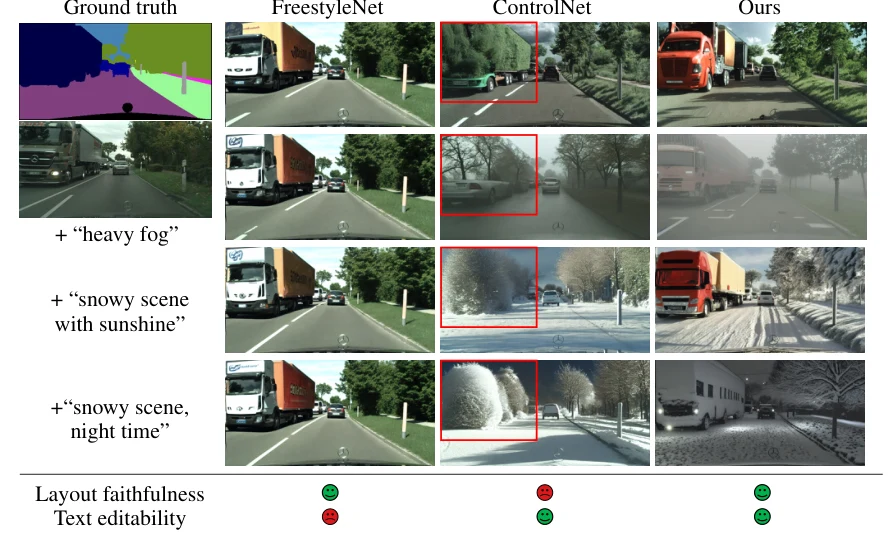
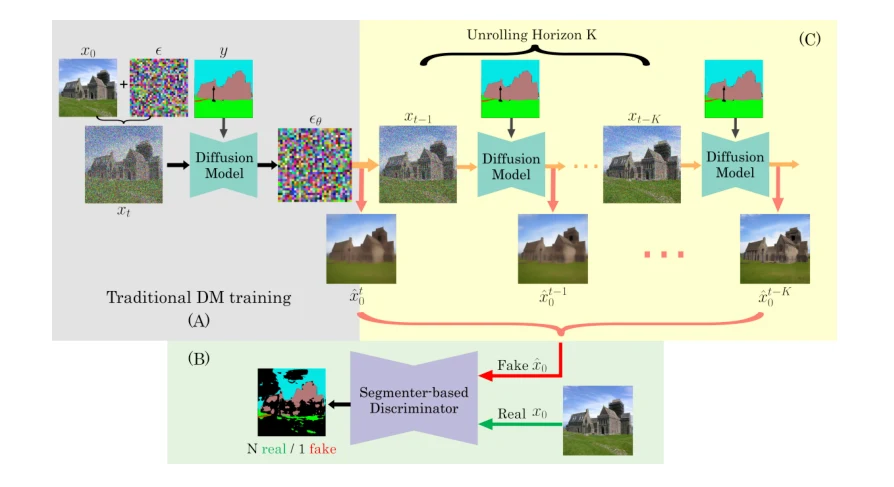
Despite the recent advances in large-scale diffusion models, little progress has been made on the layout-to-image (L2I) synthesis task. Current L2I models either suffer from poor editability via text or weak alignment between the generated image and the input layout. This limits their usability in practice. To mitigate this, we propose to integrate adversarial supervision into the conventional training pipeline of L2I diffusion models (ALDM). Specifically, we employ a segmentation-based discriminator which provides explicit feedback to the diffusion generator on the pixel-level alignment between the denoised image and the input layout. To encourage consistent adherence to the input layout over the sampling steps, we further introduce the multistep unrolling strategy. Instead of looking at a single timestep, we unroll a few steps recursively to imitate the inference process, and ask the discriminator to assess the alignment of denoised images with the layout over a certain time window. Our experiments show that ALDM enables layout faithfulness of the generated images, while allowing broad editability via text prompts. Moreover, we showcase its usefulness for practical applications: by synthesizing target distribution samples via text control, we improve domain generalization of semantic segmentation models by a large margin (∼12 mIoU points).
Figures
Cite this paper
@inproceedings{li2024adversarialsupervisionmakes40,
  title = {{Adversarial Supervision Makes Layout-to-Image Diffusion Models Thrive}},
  author = {Yumeng Li and Margret Keuper and Dan Zhang and Anna Khoreva1},
  booktitle = {International Conference on Learning Representations},
  year = {2024},
  url = {https://yumengli007.github.io/ALDM/}
}
Figures and abstract are reproduced from the linked research sources. Credit remains with the authors and publishers.