
Proceedings of the IEEE/CVF Conference on Computer Vision and Pattern Recognition Workshops (CVPRw 2024) · 2024
Are Vision Language Models Texture or Shape Biased and Can We Steer Them?
Why this publication matters
A model that understands both pictures and language may change its visual decision when the instructions change. This paper measures how such models balance object shape against texture and tests whether prompts can shift that preference. It makes the influence of everyday wording on visual reasoning measurable.
Abstract
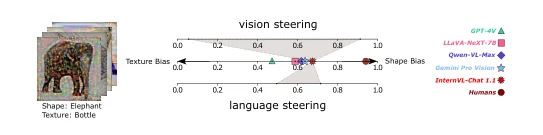
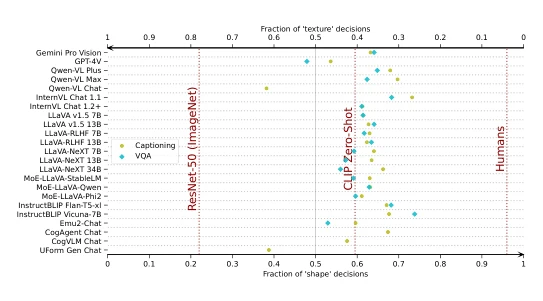
Vision language models (VLMs) have drastically changed the computer vision model landscape in only a few years, opening an exciting array of new applications from zero-shot image classification, over to image captioning, and visual question answering. Unlike pure vision models, they offer an intuitive way to access visual content through language prompting. The wide applicability of such models encourages us to ask whether they also align with human vision — specifically, how far they adopt human-induced visual biases through multimodal fusion, or whether they simply inherit biases from pure vision models. One important visual bias is the texture vs. shape bias, or the dominance of local over global information. In this paper, we study this bias in a wide range of popular VLMs. Interestingly, we find that VLMs are often more shape-biased than their vision encoders, indicating that visual biases are modulated to some extent through text in multimodal models. If text does indeed influence visual biases, this suggests that we may be able to steer visual biases not just through visual input but also through language: a hypothesis that we confirm through extensive experiments. For instance, we are able to steer shape bias from as low as 49% to as high as 72% through prompting alone. For now, the strong human bias towards shape (96%) remains out of reach for all tested VLMs.
Figures
Cite this paper
@inproceedings{gavrikov2024arevisionlanguage46,
  title = {{Are Vision Language Models Texture or Shape Biased and Can We Steer Them?}},
  author = {Paul Gavrikov and Jovita Lukasik and Steffen Jung and Robert Geirhos and Bianca Lamm and Jehanzeb Mirza and Margret Keuper and Janis Keuper},
  booktitle = {Proceedings of the IEEE/CVF Conference on Computer Vision and Pattern Recognition Workshops (CVPRw 2024)},
  year = {2024},
  url = {https://github.com/EliSchwartz/MMFM24/blob/main/52.pdf}
}
Figures and abstract are reproduced from the linked research sources. Credit remains with the authors and publishers.