
EVAL-FoMo Workshop at ECCV 24 · 2024
Can Visual Language Models Replace OCR-Based Visual Question Answering Pipelines in Production? A Case Study in Retail
Why this publication matters
Replacing a multi-step information-extraction system with one AI model is appealing, but it needs to work on the difficult details. This retail case study tests that promise on product attributes and promotional information. It identifies both useful capabilities and remaining gaps, giving a more concrete basis for production decisions.
Abstract
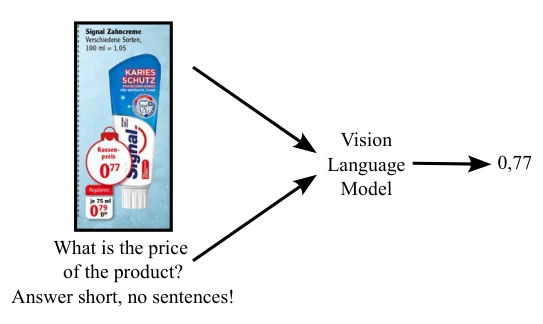
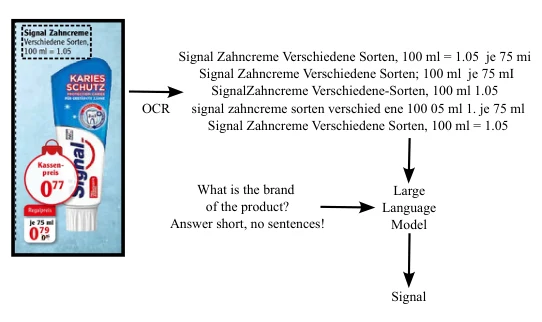
Most production-level deployments for Visual Question Answering (VQA) tasks are still build as processing pipelines of independent steps including image pre-processing, object- and text detection, Optical Character Recognition (OCR) and (mostly supervised) object classification. However, the recent advances in vision Foundation Models [25] and Vision Language Models (VLMs) [23] raise the question if these custom trained, multi-step approaches can be replaced with pre-trained, single-step VLMs. This paper analyzes the performance and limits of various VLMs in the context of VQA and OCR [5, 9, 12] tasks in a production-level scenario. Using data from the Retail-786k [10] dataset, we investigate the capabilities of pre-trained VLMs to answer detailed questions about advertised products in images. Our study includes two commercial models, GPT-4V [16] and GPT-4o [17], as well as four open-source models: InternVL [5], LLaVA 1.5 [12], LLaVA-NeXT [13], and CogAgent [9]. Our initial results show, that there is in general no big performance gap between open-source and commercial models. However, we observe a strong task dependent variance in VLM performance: while most models are able to answer questions regarding the product brand and price with high accuracy, they completely fail at the same time to correctly identity the specific product name or discount. This indicates the problem of VLMs to solve fine-grained classification tasks as well to model the more abstract concept of discounts.
Figures
Cite this paper
@inproceedings{lamm2024canvisuallanguage38,
  title = {{Can Visual Language Models Replace  OCR-Based Visual Question Answering Pipelines in Production? A Case Study in Retail}},
  author = {Bianca Lamm and Janis Keuper},
  booktitle = {EVAL-FoMo Workshop at ECCV 24},
  year = {2024},
  url = {https://arxiv.org/pdf/2408.15626}
}
Figures and abstract are reproduced from the linked research sources. Credit remains with the authors and publishers.