
Fine-Grained Visual Categorization Workshop at CVPR 2025 · 2025
A Visual RAG Pipeline for Few-Shot Fine-Grained Product Classification
Why this publication matters
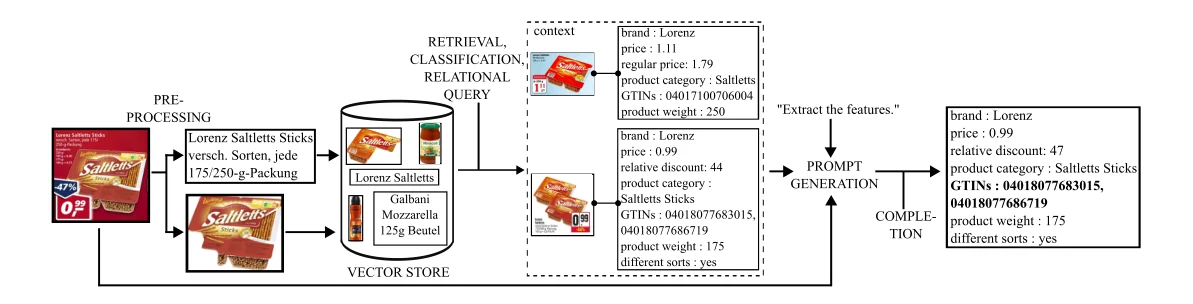
Retail catalogs change too quickly to retrain a model for every new product. This pipeline retrieves relevant examples and gives them to a vision-language model as context. It offers a way to update recognition through the reference collection while also extracting prices and promotion details.
Abstract
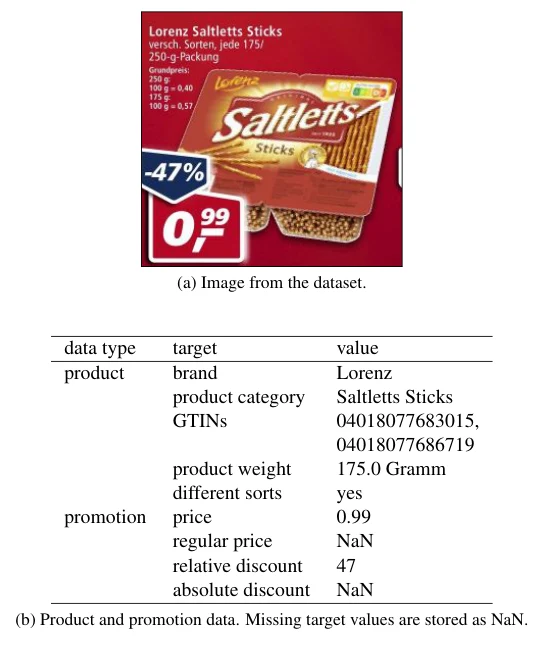
Despite the rapid evolution of learning and computer vision algorithms, Fine-Grained Classification (FGC) still poses an open problem in many practically relevant applications. In the retail domain, for example, the identification of fast changing and visually highly similar products and their properties are key to automated price-monitoring and product recommendation. This paper presents a novel Visual RAG pipeline that combines the Retrieval Augmented Generation (RAG) approach and Vision Language Models (VLMs) for few-shot FGC. This Visual RAG pipeline extracts product and promotion data in advertisement leaflets from various retailers and simultaneously predicts fine-grained product ids along with price and discount information. Compared to previous approaches, the key characteristic of the Visual RAG pipeline is that it allows the prediction of novel products without retraining, simply by adding a few class samples to the RAG database. Comparing several VLM back-ends like GPT-4o [23], GPT-4o-mini [24], and Gemini 2.0 Flash [10], our approach achieves 86.8% accuracy on a diverse dataset.
Figures
Cite this paper
@inproceedings{lamm2025avisualrag65,
  title = {{A Visual RAG Pipeline for Few-Shot Fine-Grained Product Classification}},
  author = {Bianca Lamm and Janis Keuper},
  booktitle = {Fine-Grained Visual Categorization Workshop at CVPR 2025},
  year = {2025},
  url = {https://arxiv.org/pdf/2504.11838?}
}
Figures and abstract are reproduced from the linked research sources. Credit remains with the authors and publishers.