
Proceedings of the 18th European Conference on Computer Vision (ECCV 24) · 2024
Improving Feature Stability during Upsampling-Spectral Artifacts and the Importance of Spatial Context
Why this publication matters
When a model enlarges its internal images, it can introduce artifacts that affect every predicted pixel. This work studies that problem and shows why information from a larger surrounding area is important. The findings help guide the design of models that restore images or assign labels accurately at fine spatial resolution.
Abstract
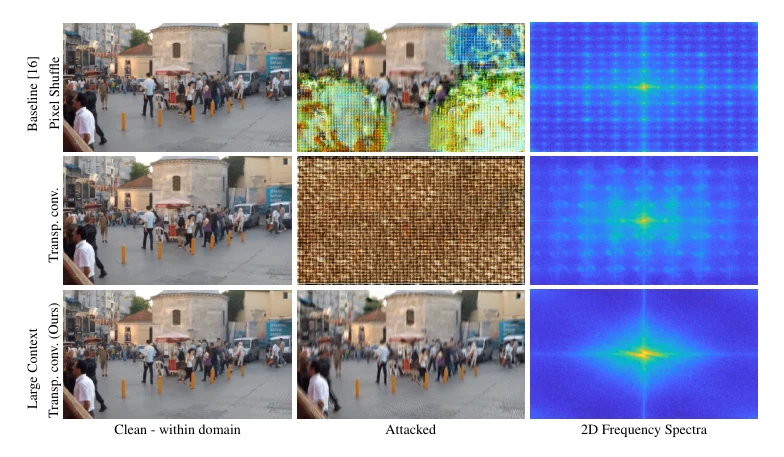
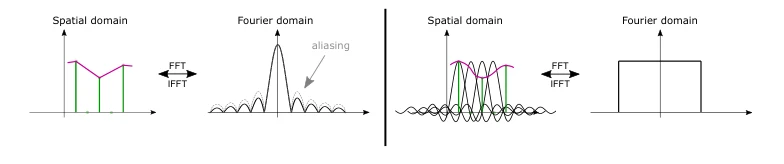
Pixel-wise predictions are required in a wide variety of tasks such as image restoration, image segmentation, or disparity estimation. Common models involve several stages of data resampling, in which the resolution of feature maps is first reduced to aggregate information and then increased to generate a high-resolution output. Previous works have shown that resampling operations are subject to artifacts such as aliasing. During downsampling, aliases have been shown to compromise the prediction stability of image classifiers. During upsampling, they have been leveraged to detect generated content. Yet, the effect of aliases during upsampling has not yet been discussed w.r.t. the stability and robustness of pixel-wise predictions. While falling under the same term (aliasing), the challenges for correct upsampling in neural networks differ significantly from those during downsampling: when downsampling, some high frequencies can not be correctly represented and have to be removed to avoid aliases. However, when upsampling for pixel-wise predictions, we actually require the model to restore such high frequencies that can not be encoded in lower resolutions. The application of findings from signal processing is therefore a necessary but not a sufficient condition to achieve the desirable output. In contrast, we find that the availability of large spatial context during upsampling allows to provide stable, high-quality pixel-wise predictions, even when fully learning all filter weights.
Figures
Cite this paper
@inproceedings{agnihotri2024improvingfeaturestability36,
  title = {{Improving Feature Stability during Upsampling-Spectral Artifacts and the Importance of Spatial Context}},
  author = {Shashank Agnihotri and Julia Grabinski and Margret Keuper},
  booktitle = {Proceedings of the 18th European Conference on Computer Vision (ECCV 24)},
  year = {2024},
  url = {https://pure.mpg.de/rest/items/item_3611850_1/component/file_3611851/content}
}
Figures and abstract are reproduced from the linked research sources. Credit remains with the authors and publishers.