
Proceedings of the IEEE/CVF Conference on Computer Vision and Pattern Recognition Workshops (CVPRw 2025) · 2025
Are Synthetic Corruptions A Reliable Proxy For Real-World Corruptions?
Why this publication matters
Artificial fog or noise is convenient for testing vision models, but it needs to tell us something about real conditions. This study compares synthetic tests with actual adverse-weather images. It identifies useful overall relationships while showing why conclusions about individual corruptions need more care.
Abstract
Deep learning (DL) models are widely used in real-world applications but remain vulnerable to distribution shifts, especially due to weather and lighting changes. Collecting diverse real-world data for testing the robustness of DL models is resource-intensive, making synthetic corruptions an attractive alternative for robustness testing. However, are synthetic corruptions a reliable proxy for real-world corruptions? To answer this, we conduct the largest benchmarking study on semantic segmentation models, comparing performance on real-world corruptions and synthetic corruptions datasets. Our results reveal a strong correlation in mean performance, supporting the use of synthetic corruptions for robustness evaluation. We further analyze corruption-specific correlations, providing key insights to understand when synthetic corruptions succeed in representing real-world corruptions. Open-source Code.
Figures
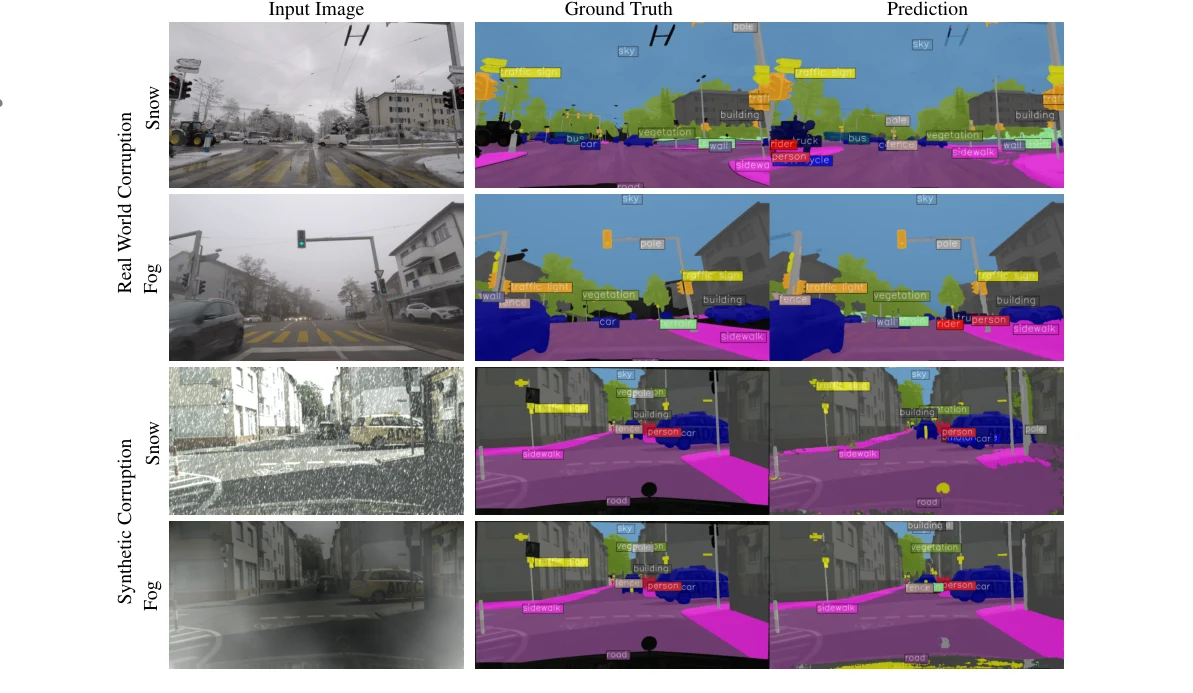
![To empirically determine if synthetic common corruptions such as those proposed by [31] truly represent the distribution and domain shifts in the real world, we try to find correlations in evaluations on ACDC and 2D Common Corruptions.](/images/publications/details/062-figure-2.webp)
Cite this paper
@inproceedings{agnihotri2025aresyntheticcorruptions62,
  title = {{Are Synthetic Corruptions A Reliable Proxy For Real-World Corruptions?}},
  author = {S. Agnihotri and D. Schader and N. Sharei and M. Keuper},
  booktitle = {Proceedings of the IEEE/CVF Conference on Computer Vision and Pattern Recognition Workshops (CVPRw 2025)},
  year = {2025},
  url = {https://openreview.net/forum?id=mPqVEApjIw}
}
Figures and abstract are reproduced from the linked research sources. Credit remains with the authors and publishers.