NeuSLAM Workshop at ECCV 26 · 2026
Failure or Drift? Evaluating Monocular SLAM under Synthetic and Real-World Corruptions
Why this publication matters
A camera-based mapping system can keep running while its estimated path becomes increasingly wrong. This study separates complete tracking failures from that quieter accumulation of error. It also tests when artificial image corruptions reproduce conclusions from real conditions, making tracker comparisons more useful for deployment.
Abstract
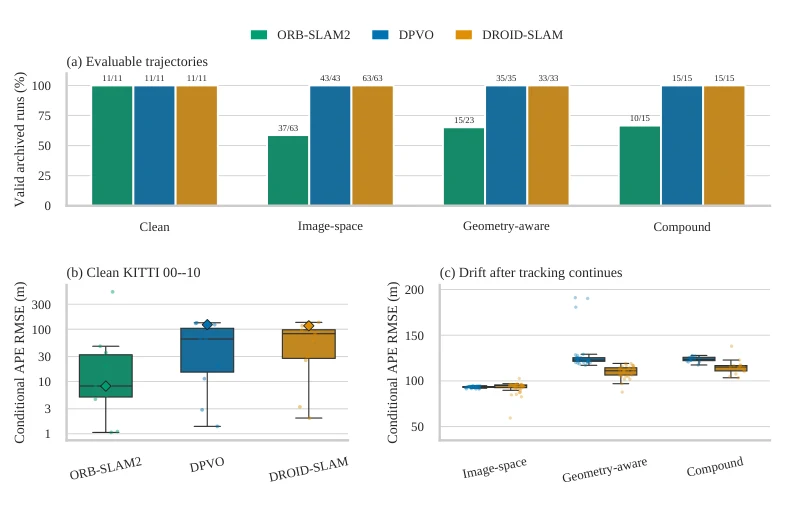
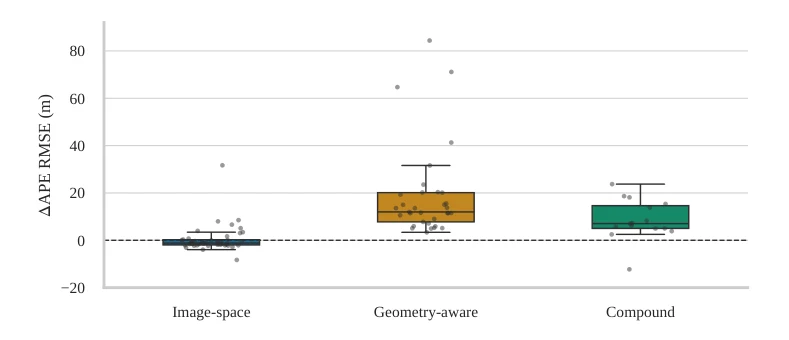
Visual SLAM is commonly evaluated on clean trajectories, although deployment failures are often caused by adverse weather, illumination, blur, and sensor artifacts. Controlled corruptions are attractive because they isolate such factors, but a synthetic stress test is useful only when it leads to the same engineering conclusion as the condition it is intended to approximate. This work examines that question for monocular SLAM. We evaluate a classical feature-based system and two learned trackers under image-space, geometry-aware, and compound corruptions, and compare their behavior with adverse conditions from 4Seasons. Rather than reducing robustness to a single trajectory error, the evaluation separates explicit tracking failure from drift accumulated by methods that remain active. The results show that learned trackers largely replace catastrophic loss with sustained, and sometimes severe, drift. More importantly, the apparent ordering of the learned systems changes with the physical fidelity of the corruption: structured rain and fog proxies preserve the real-world ordering, whereas a simple illumination proxy does not. Code is available in this: GitHub repository.
Figures
Cite this paper
@inproceedings{thomas2026failureordrift94,
  title = {{Failure or Drift? Evaluating Monocular SLAM under Synthetic and Real-World Corruptions}},
  author = {Abhay Skaria Thomas and Shashank Agnihotri and Margret Keuper},
  booktitle = {NeuSLAM Workshop at ECCV 26},
  year = {2026},
  url = {https://arxiv.org/abs/2608.30690}
}
Figures and abstract are reproduced from the linked research sources. Credit remains with the authors and publishers.