
ICML 25 · 2025
DCBM - Data-Efficient Visual Concept Bottleneck Models
Why this publication matters
An interpretable classifier should show which visual evidence supports its answer. DCBM learns a compact collection of concepts from image regions and can locate those concepts in new examples. It offers an efficient approach for specialized recognition tasks where both training data and understandable explanations matter.
Abstract
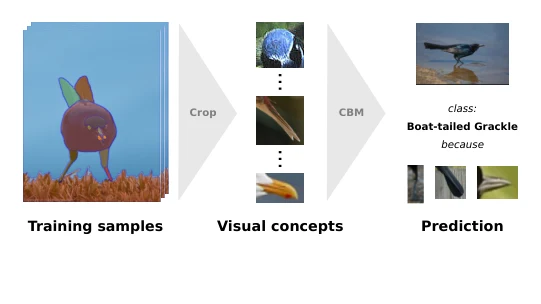
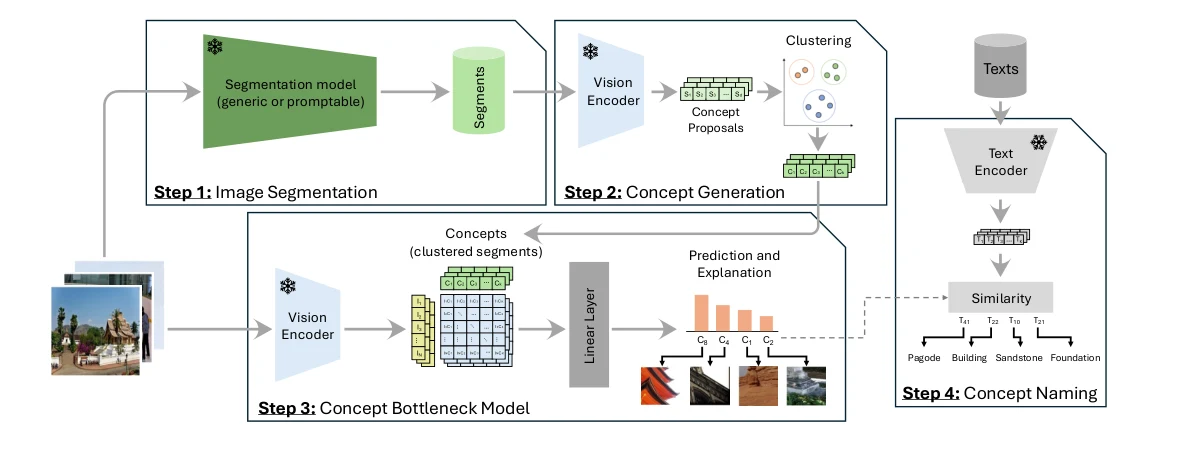
Concept Bottleneck Models (CBMs) enhance the interpretability of neural networks by basing predictions on human-understandable concepts. However, current CBMs typically rely on concept sets extracted from large language models or extensive image corpora, limiting their effectiveness in data-sparse scenarios. We propose Data-efficient CBMs (DCBMs), which reduce the need for large sample sizes during concept generation while preserving interpretability. DCBMs define concepts as image regions detected by segmentation or detection foundation models, allowing each image to generate multiple concepts across different granularities. Exclusively containing dataset-specific concepts, DCBMs are well suited for fine-grained classification and outof-distribution tasks. Attribution analysis using Grad-CAM demonstrates that DCBMs deliver visual concepts that can be localized in test images. By leveraging dataset-specific concepts instead of predefined or general ones, DCBMs enhance adaptability to new domains. The code is available at: https://github.com/KathPra/DCBM.
Figures
Cite this paper
@inproceedings{prasse2025dcbmdataefficient67,
  title = {{DCBM - Data-Efficient Visual Concept Bottleneck Models}},
  author = {Katharina Prasse and Patrick Knab and Sascha Marton and Christian Bartelt and Margret Keuper},
  booktitle = {International Conference on Machine Learning},
  year = {2025},
  url = {https://arxiv.org/pdf/2412.11576}
}
Figures and abstract are reproduced from the linked research sources. Credit remains with the authors and publishers.