
Proceedings of the IEEE/CVF International Conference on Computer Vision (ICCV 2025) · 2025
AIM - Amending Inherent Interpretability via Self-Supervised Masking
Why this publication matters
A useful explanation should reflect what a classifier actually uses, rather than being added only after the decision. AIM uses masking during training to encourage reliance on meaningful object features. It improves the connection between recognition and visible evidence without requiring extra region annotations.
Abstract
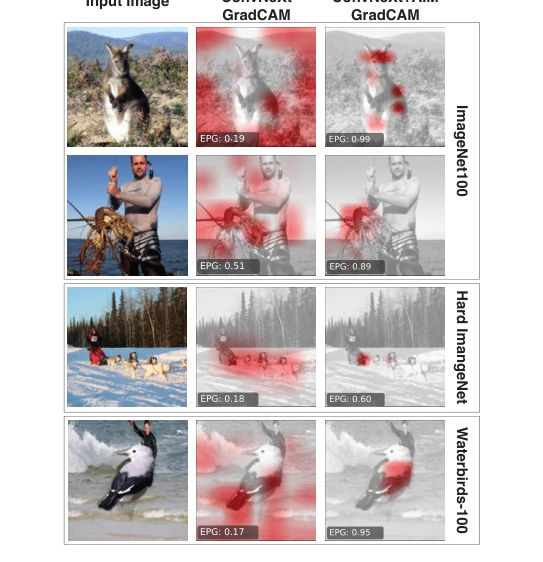
It has been observed that deep neural networks (DNNs) often use both genuine as well as spurious features. In this work, we propose “Amending Inherent Interpretability via Self-Supervised Masking” (AIM), a simple yet interestingly effective method that promotes the network’s utilization of genuine features over spurious alternatives without requiring additional annotations. In particular, AIM uses features at multiple encoding stages to guide a selfsupervised, sample-specific feature-masking process. As a result, AIM enables the training of well-performing and inherently interpretable models that faithfully summarize the decision process. We validate AIM across a diverse range of challenging datasets that test both out-of-distribution generalization and fine-grained visual understanding. These include general-purpose classification benchmarks such as ImageNet100, HardImageNet, and ImageWoof, as well as fine-grained classification datasets such as Waterbirds, TravelingBirds, and CUB-200. AIM demonstrates significant dual benefits: interpretability improvements, as measured by the Energy Pointing Game (EPG) score, and accuracy gains over strong baselines. These consistent gains across domains and architectures provide compelling evidence that AIM promotes the use of genuine and meaningful features that directly contribute to improved generalization and human-aligned interpretability.
Figures
![Abstract Diagram of the [backbone]+AIM Architecture.](/images/publications/details/074-figure-2.webp)
Cite this paper
@inproceedings{alshami2025aimamendinginherent74,
  title = {{AIM - Amending Inherent Interpretability via Self-Supervised Masking}},
  author = {Eyad Alshami and Shashank Agnihotri and Bernt Schiele and Margret Keuper},
  booktitle = {Proceedings of the IEEE/CVF International Conference on Computer Vision (ICCV 2025)},
  year = {2025},
  url = {https://arxiv.org/abs/2508.11502}
}
Figures and abstract are reproduced from the linked research sources. Credit remains with the authors and publishers.