
Proceedings of the IEEE/CVF International Conference on Computer Vision (ICCV 2025) · 2025
TikZero - Zero-Shot Text-Guided Graphics Program Synthesis
Why this publication matters
A scientific figure is more useful when it can be edited as code instead of remaining a flat image. TikZero connects a written description to graphics-program generation without requiring paired descriptions and programs for training. It opens a route to reusable, editable illustrations from natural-language requests.
Abstract
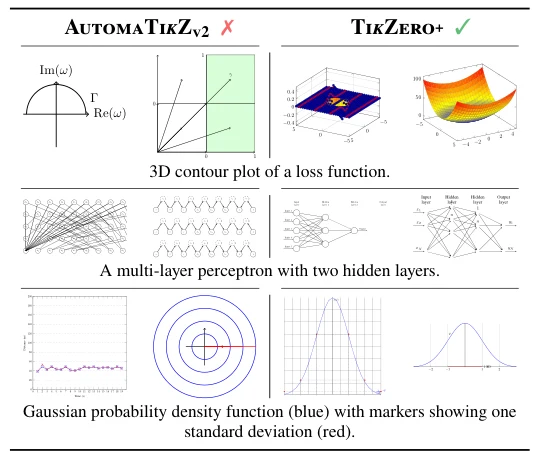
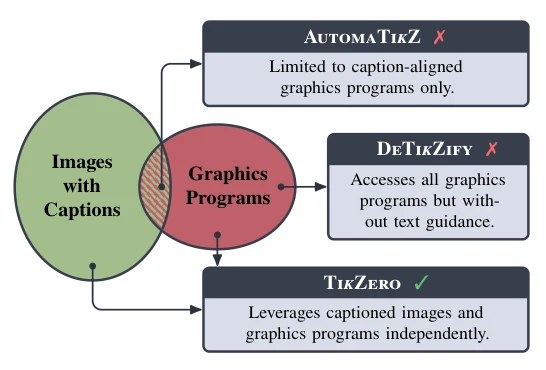
Automatically synthesizing figures from text captions is a compelling capability. However, achieving high geometric precision and editability requires representing figures as graphics programs in languages like TikZ, and aligned training data (i.e., graphics programs with captions) remains scarce. Meanwhile, large amounts of unaligned graphics programs and captioned raster images are more readily available. We reconcile these disparate data sources by presenting TikZero, which decouples graphics program generation from text understanding by using image representations as an intermediary bridge. It enables independent training on graphics programs and captioned images and allows for zero-shot text-guided graphics program synthesis during inference. We show that our method substantially outperforms baselines that can only operate with caption-aligned graphics programs. Furthermore, when leveraging caption-aligned graphics programs as a complementary training signal, TikZero matches or exceeds the performance of much larger models, including commercial systems like GPT-4o. Our code, datasets, and select models are publicly available.
Figures
Cite this paper
@inproceedings{belouadi2025tikzerozeroshot73,
  title = {{TikZero - Zero-Shot Text-Guided Graphics Program Synthesis}},
  author = {Jonas Belouadi and Eddy Ilg and Margret Keuper and Hideki Tanaka and Masao Utiyama and Raj Dabre and Steffen Eger and Simone Paolo Ponzetto},
  booktitle = {Proceedings of the IEEE/CVF International Conference on Computer Vision (ICCV 2025)},
  year = {2025},
  url = {https://arxiv.org/abs/2503.11509}
}
Figures and abstract are reproduced from the linked research sources. Credit remains with the authors and publishers.