
Proceedings of the Nineth International Conference on Learning Representations (ICLR 25) · 2025
VSTAR Generative Temporal Nursing for Longer Dynamic Video Synthesis
Why this publication matters
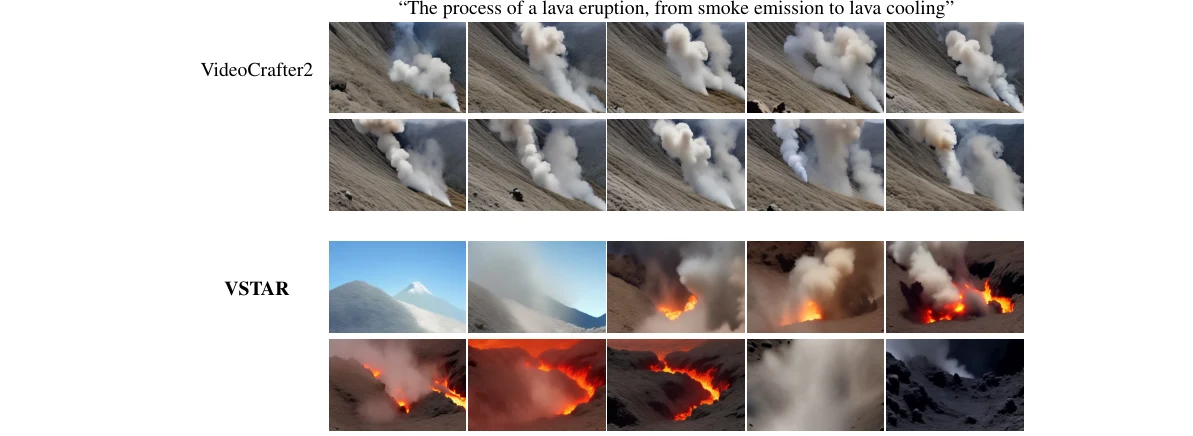
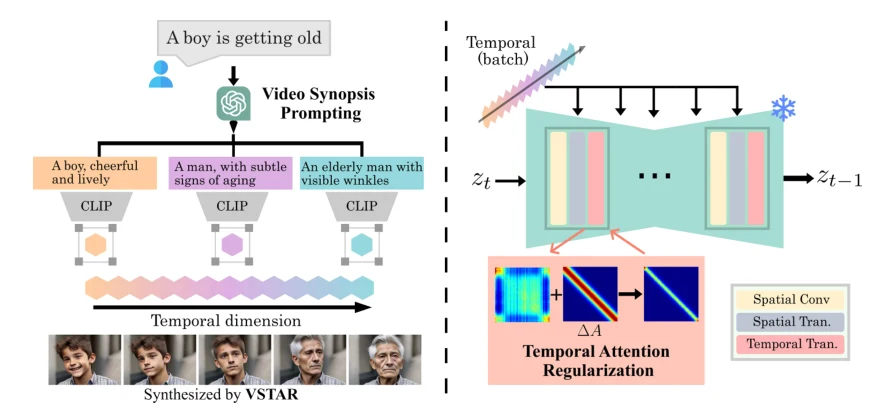
A longer generated video is not necessarily a more interesting one if little changes over time. VSTAR uses a sequence of descriptions and changes to temporal attention to guide how a scene evolves. It extends the usefulness of pretrained video generators for prompts that describe a developing sequence of events.
Abstract
Despite tremendous progress in the field of text-to-video (T2V) synthesis, opensourced T2V diffusion models struggle to generate longer videos with dynamically varying and evolving content. They tend to synthesize quasi-static videos, ignoring the necessary visual change-over-time implied in the text prompt. At the same time, scaling these models to enable longer, more dynamic video synthesis often remains computationally intractable. To address this challenge, we introduce the concept of Generative Temporal Nursing (GTN), where we aim to alter the generative process on the fly during inference to improve control over the temporal dynamics and enable generation of longer videos. We propose a method for GTN, dubbed VSTAR, which consists of two key ingredients: 1) Video Synopsis Prompting (VSP) - automatic generation of a video synopsis based on the original single prompt leveraging LLMs, which gives accurate textual guidance to different visual states of longer videos, and 2) Temporal Attention Regularization (TAR) - a regularization technique to refine the temporal attention units of the pre-trained T2V diffusion models, which enables control over the video dynamics. We experimentally showcase the superiority of the proposed approach in generating longer, visually appealing videos over existing open-sourced T2V models. We additionally analyze the temporal attention maps realized with and without VSTAR, demonstrating the importance of applying our method to mitigate neglect of the desired visual change over time.
Figures
Cite this paper
@inproceedings{li2025vstargenerativetemporal57,
  title = {{VSTAR Generative Temporal Nursing for Longer Dynamic Video Synthesis}},
  author = {Yumeng Li and William Beluch and Margret Keuper and Dan Zhang and Anna Khoreva},
  booktitle = {International Conference on Learning Representations},
  year = {2025},
  url = {https://yumengli007.github.io/VSTAR/}
}
Figures and abstract are reproduced from the linked research sources. Credit remains with the authors and publishers.