ICML Workshops 26 · 2026
Images as Tables - In-Context Learning with TabPFN for Low-Data Detection of AI-Generated Images
Why this publication matters
A detector trained on yesterday's image generator may struggle with tomorrow's. This method combines fixed image features with a model that learns from a small set of examples provided as context. It offers a lightweight way to adapt detection without repeatedly retraining a large vision network.
Abstract
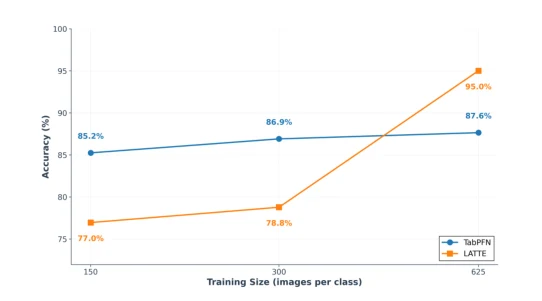
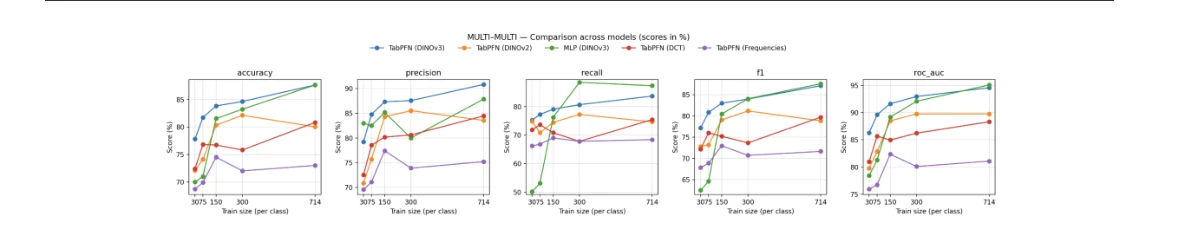
AI-generated image detection is a moving-target problem: detectors trained on one generator often fail when a new generator appears, and only a few labeled examples are available. We study a simple image-to-table formulation for this regime, where each image is encoded by a frozen DINOv3 backbone, its CLS feature is reduced to a 500-dimensional structured row with PCA, and TabPFN performs real/fake classification by incontext tabular inference rather than task-specific classifier training. This turns fake-image detection into low-data structured prediction over learned visual features, making detector adaptation depend on the labeled context set instead of gradient-based fine-tuning. On GenImage, LATTE, a recent state-of-the-art detector, remains stronger when many labeled samples from all generators are available, by 7.4% in the largest pooled setting, but DINOv3-PCA-TabPFN is stronger in the practically important low-data regime, outperforming LATTE by up to 8.2%, and in transfer settings where the detector must generalize from one generator to another. These results position tabular foundation models as a strong complementary adaptation mechanism for image forensics, shifting adaptation from detector retraining to lightweight in-context updates with a small labeled set of examples. Code hyperlink here.
Figures
Cite this paper
@inproceedings{walter2026imagesastables82,
  title = {{Images as Tables - In-Context Learning with TabPFN for Low-Data Detection of AI-Generated Images}},
  author = {Jan Philip Walter and Shashank Agnihotri and Margret Keuper},
  booktitle = {ICML Workshops 26},
  year = {2026},
  url = {https://arxiv.org/pdf/2606.00872}
}
Figures and abstract are reproduced from the linked research sources. Credit remains with the authors and publishers.