
exCV Workshop at ECCV 26 · 2026
Position: We need theory-grounded explainability for abstract classification to quantify model bias
Why this publication matters
People do not all mean the same thing when they call an image wealthy or affluent. This paper shows that models overlook some human wealth cues and that human ratings of generated scenes vary across countries. It argues for defining the social context and using validated measures, so that explanations can support a meaningful assessment of bias.
Abstract
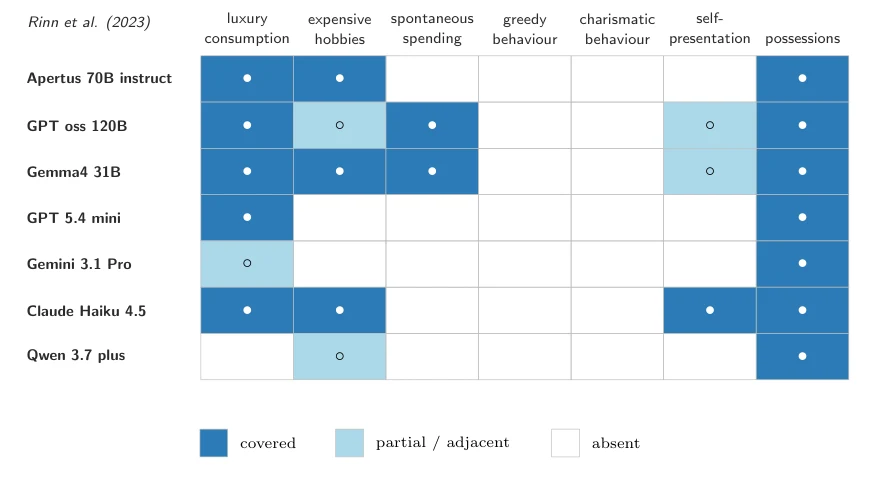
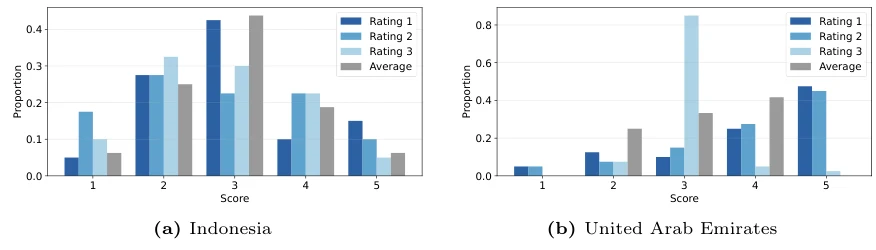
Explainability for denotative and connotative tasks differs fundamentally. While denotative features (e.g. of a bird species or of a melanoma) can be universally agreed upon, representations of connotative classes (e.g. wealth of a person or affluence) are subject to cultural, geographic location, and personal beliefs. Because images offer a richer contextual signal compared to text, they may amplify model bias. We advocate for explainability in abstract classification tasks on the basis of two case studies: (1) Comparing seven foundation models in their perception of personal wealth against a psychologically validated survey on wealth cues shows that models collectively omit the character dimensions of the taxonomy. (2) Human annotators reach satisfactory levels of agreement (Krippendorff’s α ≥0.67) on affluence in generated images in 3 / 14 assessed countries. Current XAI methods lack a validated ontology to evaluate abstract classes against and thus seemingly plausible explanations may be inadequate for the given task. We argue that abstract classification requires an explicit declaration of context - population, geographic location, cultural norm, time frame - and an externally validated measure suitable for the specific context. This renders classification bias quantifiable and models steerable.
Figures
Cite this paper
@inproceedings{prasse2026weneedtheory95,
  title = {{Position: We need theory-grounded explainability for abstract classification to quantify model bias}},
  author = {Katharina Prasse and Margret Keuper},
  booktitle = {exCV Workshop at ECCV 26},
  year = {2026},
  url = {https://openreview.net/forum?id=Oz2id4l0SX}
}
Figures and abstract are reproduced from the linked research sources. Credit remains with the authors and publishers.