
Proceedings of the IEEE/CVF Conference on Computer Vision and Pattern Recognition (CVPR 2021) · 2021
Multi-Class Multi-Instance Count Conditioned Adversarial Image Generation
Why this publication matters
Asking a generator for a street scene is easier than asking for exactly two cars and three people. This paper makes object counts an explicit part of image generation and checks those counts during training. That brings more direct control to a task in which visually attractive results can otherwise ignore basic instructions.
Abstract
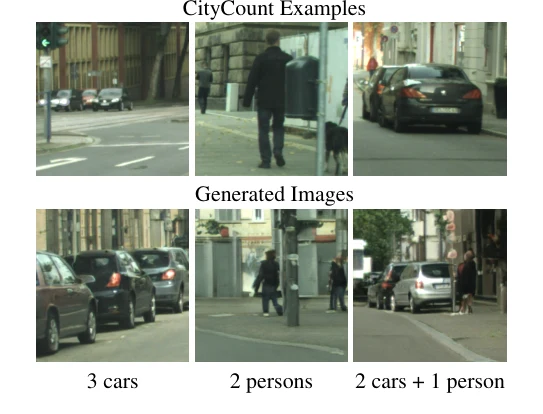
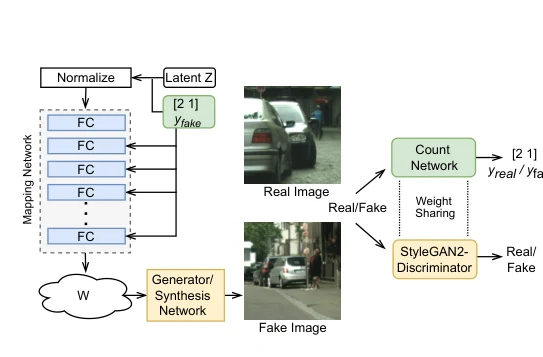
Image generation has rapidly evolved in recent years. Modern architectures for adversarial training allow to generate even high resolution images with remarkable quality. At the same time, more and more effort is dedicated towards controlling the content of generated images. In this paper, we take one further step in this direction and propose a conditional generative adversarial network (GAN) that generates images with a defined number of objects from given classes. This entails two fundamental abilities (1) being able to generate high-quality images given a complex constraint and (2) being able to count object instances per class in a given image. Our proposed model modularly extends the successful StyleGAN2 architecture with a count-based conditioning as well as with a regression subnetwork to count the number of generated objects per class during training. In experiments on three different datasets, we show that the proposed model learns to generate images according to the given multiple-class count condition even in the presence of complex backgrounds. In particular, we propose a new dataset, CityCount, which is derived from the Cityscapes street scenes dataset, to evaluate our approach in a challenging and practically relevant scenario. An implementation is available at https://github.com/boschresearch/MCCGAN.
Figures
Cite this paper
@inproceedings{saseendran2021multiclassmulti7,
  title = {{Multi-Class Multi-Instance Count Conditioned Adversarial Image Generation}},
  author = {Amrutha Saseendran and Kathrin Skubch and Margret Keuper},
  booktitle = {Proceedings of the IEEE/CVF Conference on Computer Vision and Pattern Recognition (CVPR 2021)},
  year = {2021},
  url = {https://openaccess.thecvf.com/content/ICCV2021/papers/Saseendran_Multi-Class_Multi-Instance_Count_Conditioned_Adversarial_Image_Generation_ICCV_2021_paper.pdf}
}
Figures and abstract are reproduced from the linked research sources. Credit remains with the authors and publishers.