
Proceedings of the IEEE/CVF Conference on Computer Vision and Pattern Recognition Workshops (CVPRW 2023) · 2023
Happy People -- Image Synthesis as Black-Box Optimization Problem in the Discrete Latent Space of Deep Generative Models
Why this publication matters
Can a generator deliberately produce examples beyond the typical range of its training images? This paper uses increasingly happy-looking faces as a controlled demonstration of that question. The value is a principled way to study and optimize a generator's outputs, rather than a claim that smile generation itself solves an important application problem.
Abstract
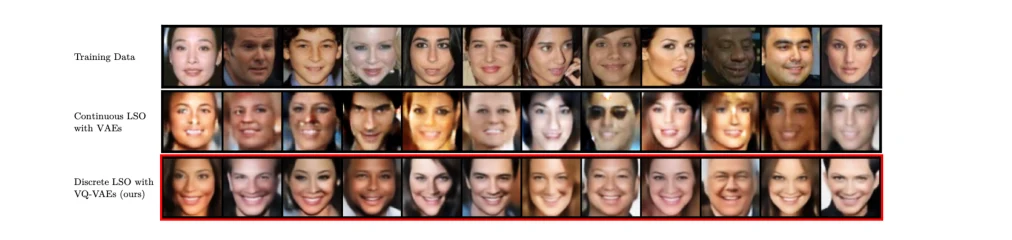
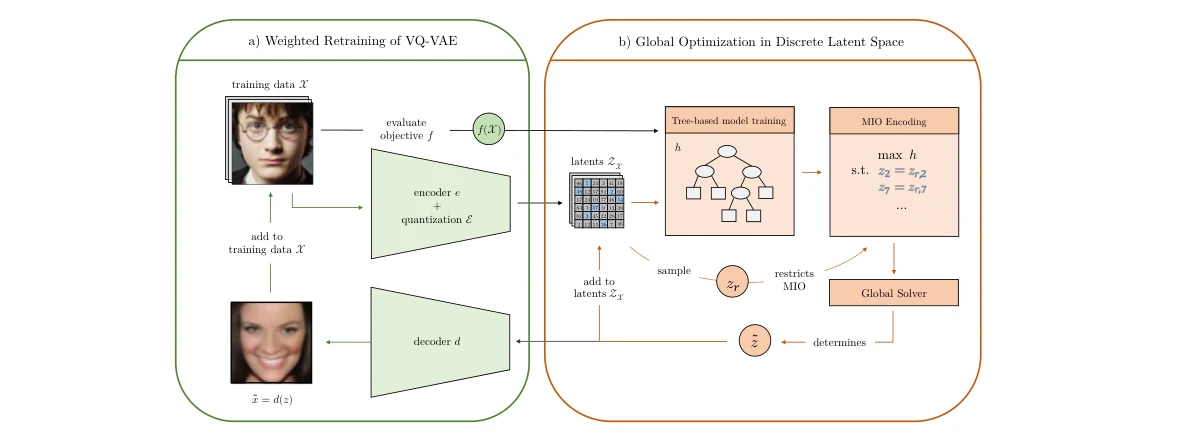
In recent years, optimization in the learned latent space of deep generative models has been successfully applied to black-box optimization problems such as drug design, image generation or neural architecture search. Existing models thereby leverage the ability of neural models to learn the data distribution from a limited amount of samples such that new samples from the distribution can be drawn. In this work, we propose a novel image generative approach that optimizes the generated sample with respect to a continuously quantifiable property. While we anticipate absolutely no practically meaningful application for the proposed framework, it is theoretically principled and allows to quickly propose samples at the mere boundary of the training data distribution. Specifically, we propose to use tree-based ensemble models as mathematical programs over the discrete latent space of vector quantized VAEs, which can be globally solved. Subsequent weighted retraining on these queries allows to induce a distribution shift. In lack of a practically relevant problem, we consider a visually appealing application: the generation of happily smiling faces (where the training distribution only contains less happy people) - and show the principled behavior of our approach in terms of improved FID and higher smile degree over baseline approaches.
Figures
Cite this paper
@inproceedings{jung2023happypeopleimage27,
  title = {{Happy People -- Image Synthesis as Black-Box Optimization Problem in the Discrete Latent Space of Deep Generative Models}},
  author = {Steffen Jung and Jan Christian Schwedhelm and Claudia Schillings and Margret Keuper},
  booktitle = {Proceedings of the IEEE/CVF Conference on Computer Vision and Pattern Recognition Workshops (CVPRW 2023)},
  year = {2023},
  url = {https://arxiv.org/pdf/2306.06684}
}
Figures and abstract are reproduced from the linked research sources. Credit remains with the authors and publishers.