
Environmental Data Science Journal · 2022
Physics-informed learning of aerosol microphysics
Why this publication matters
Tiny airborne particles have an important effect on climate, but simulating their behavior is computationally costly. This work learns a fast approximation of the underlying microphysics and adds constraints based on physical knowledge. It demonstrates a route toward cheaper calculations while addressing requirements such as conserving mass.
Abstract
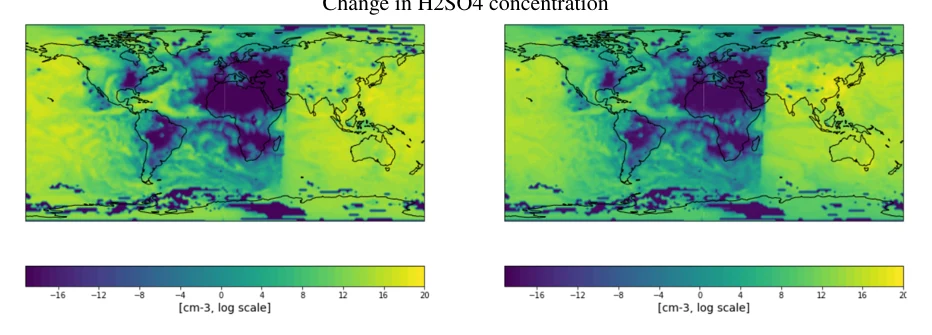
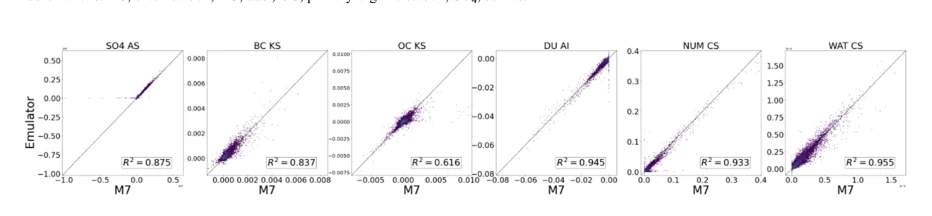
Aerosol particles play an important role in the climate system by absorbing and scattering radiation and influencing cloud properties. They are also one of the biggest sources of uncertainty for climate modeling. Many climate models do not include aerosols in sufficient detail due to computational constraints. To represent key processes, aerosol microphysical properties and processes have to be accounted for. This is done in the ECHAM-HAM (European Center for Medium-Range Weather Forecast-Hamburg-Hamburg) global climate aerosol model using the M7 microphysics, but high computational costs make it very expensive to run with finer resolution or for a longer time. We aim to use machine learning to emulate the microphysics model at sufficient accuracy and reduce the computational cost by being fast at inference time. The original M7 model is used to generate data of input–output pairs to train a neural network (NN) on it. We are able to learn the variables’ tendencies achieving an average R² score of 77.1%. We further explore methods to inform and constrain the NN with physical knowledge to reduce mass violation and enforce mass positivity. On a Graphics processing unit (GPU), we achieve a speed-up of up to over 64 times faster when compared to the original model.
Figures
Cite this paper
@article{harder2022physicsinformedlearning19,
  title = {{Physics-informed learning of aerosol microphysics}},
  author = {Paula Harder and Duncan Watson-Parris and Philip Stier and Dominik Strassel and Nicolas R Gauger and Janis Keuper},
  journal = {Environmental Data Science},
  year = {2022},
  url = {https://www.cambridge.org/core/services/aop-cambridge-core/content/view/C468660D2AEE8E25DC3BF507517FF91A/S263446022200022Xa.pdf/div-class-title-physics-informed-learning-of-aerosol-microphysics-div.pdf}
}
Figures and abstract are reproduced from the linked research sources. Credit remains with the authors and publishers.