Proceedings of the IEEE/CVF Conference on Computer Vision and Pattern Recognition (CVPR 2025) · 2025
PhysicsGen - Can Generative Models Learn from Images to Predict Complex Physical Relations?
Why this publication matters
A plausible-looking simulation is not necessarily a physically correct one. PhysicsGen tests image-based generative models on several physical problems so that their errors can be examined systematically. It helps researchers judge where fast learned approximations are useful and where stronger physical constraints are needed.
Abstract
The image-to-image translation abilities of generative learning models have recently made significant progress in the estimation of complex (steered) mappings between image distributions. While appearance based tasks like image in-painting or style transfer have been studied at length, we propose to investigate the potential of generative models in the context of physical simulations. Providing a dataset of 300k image-pairs and baseline evaluations for three different physical simulation tasks, we propose a benchmark to investigate the following research questions: i) are generative models able to learn complex physical relations from input-output image pairs? ii) what speedups can be achieved by replacing differential equation based simulations? While baseline evaluations of different current models show the potential for high speedups (ii), these results also show strong limitations toward the physical correctness (i). This underlines the need for new methods to enforce physical correctness. Data, baseline models and evaluation code: http://www.physics-gen.org.
Figures
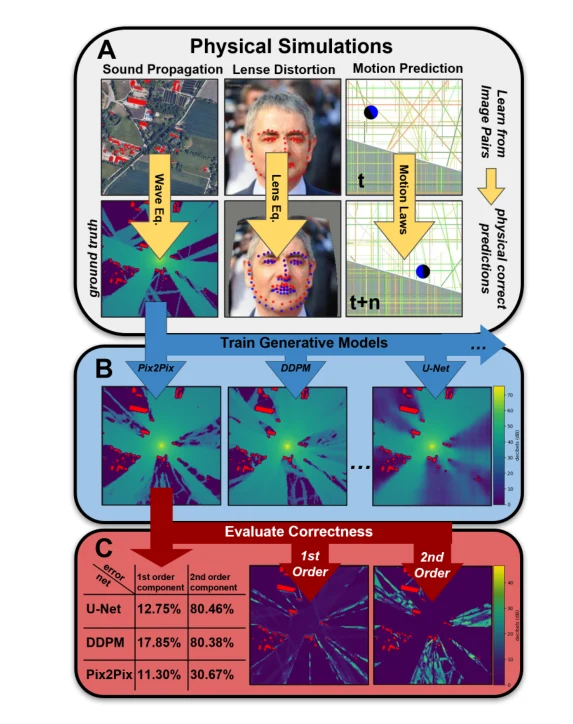
![The sampling pipeline for the sound propagation dataset utilizes the NoiseModelling framework [4] to generate sound propagation maps based on specific urban layouts.](/images/publications/details/066-figure-2.webp)
Cite this paper
@inproceedings{spitznagel2025physicsgencangenerative66,
  title = {{PhysicsGen - Can Generative Models Learn from Images to Predict Complex Physical Relations?}},
  author = {Martin Spitznagel and Jan Vailant and Janis Keuper},
  booktitle = {Proceedings of the IEEE/CVF Conference on Computer Vision and Pattern Recognition (CVPR 2025)},
  year = {2025},
  url = {https://arxiv.org/abs/2503.05333}
}
Figures and abstract are reproduced from the linked research sources. Credit remains with the authors and publishers.