
NeurIPS 25 Workshop on UrbanAI · 2025
Real-time Prediction of Urban Sound Propagation with Conditioned Normalizing Flows
Why this publication matters
Urban planners may need to compare many changes to roads, buildings, or noise sources. Detailed sound simulations can make that interactive exploration slow. This learned model predicts sound maps rapidly, offering a practical way to explore alternatives before undertaking more expensive analysis.
Abstract
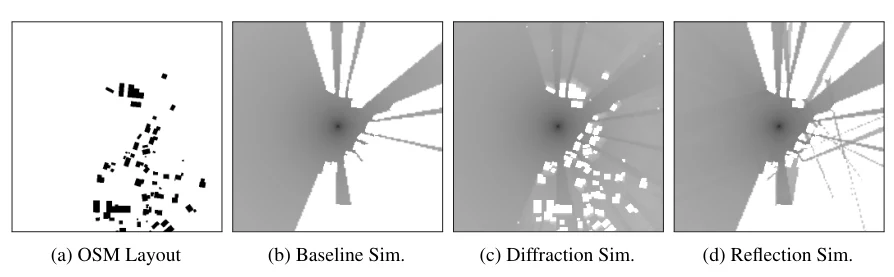
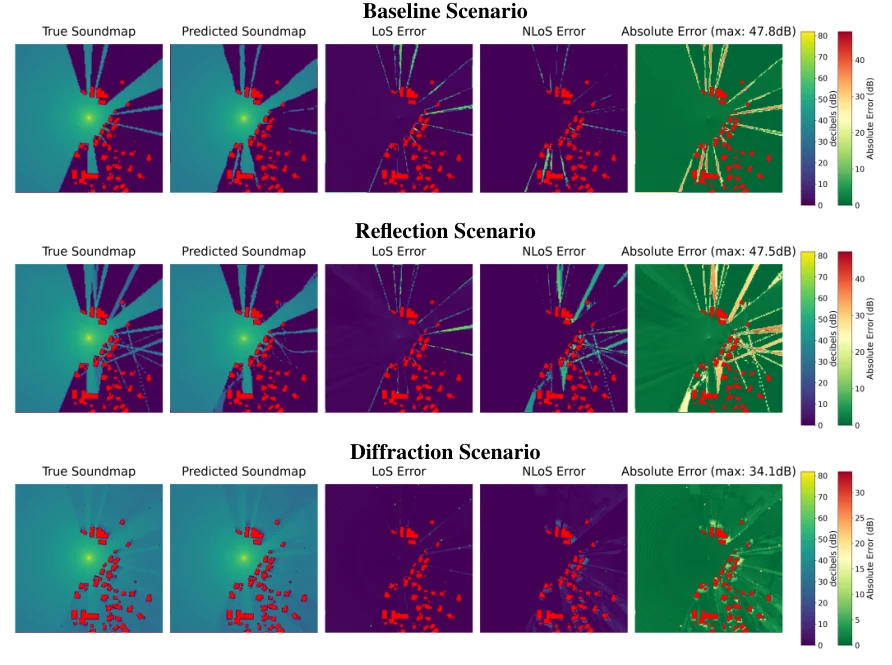
Accurate and fast urban noise prediction is pivotal for public health and for regulatory workflows in cities, where the Environmental Noise Directive mandates regular strategic noise maps and action plans, often needed in permission workflows, rightof-way allocation, and construction scheduling. Physics-based solvers are too slow for such time-critical, iterative “what-if” studies. We evaluate conditional Normalizing Flows (Full-Glow) for generating for generating standards-compliant urban sound-pressure maps from 2D urban layouts in real time (≈102 ms per 256×256 map on a single RTX 4090), enabling interactive exploration directly on commodity hardware. On datasets covering Baseline, Diffraction, and Reflection regimes, our model accelerates map generation by >2000× over a reference solver while improving NLoS accuracy by up to 24% versus prior deep models; in Baseline NLoS we reach 0.65 dB MAE with high structural fidelity. The model reproduces diffraction and interference patterns and supports instant recomputation under source or geometry changes, making it a practical engine for urban planning, compliance mapping, and operations (e.g., temporary road closures, night-work variance assessments).
Figures
Cite this paper
@inproceedings{eckerle2025realtimeprediction76,
  title = {{Real-time Prediction of Urban Sound Propagation with Conditioned Normalizing Flows}},
  author = {Achim Eckerle and Martin Spitznage and Janis Keuper},
  booktitle = {NeurIPS 25 Workshop on UrbanAI},
  year = {2025},
  url = {https://arxiv.org/pdf/2510.04510}
}
Figures and abstract are reproduced from the linked research sources. Credit remains with the authors and publishers.