
eCVX Workshop at ECCV 24 · 2024
Top-GAP - Integrating Size Priors in CNNs for more Interpretability, Robustness, and Bias Mitigation
Why this publication matters
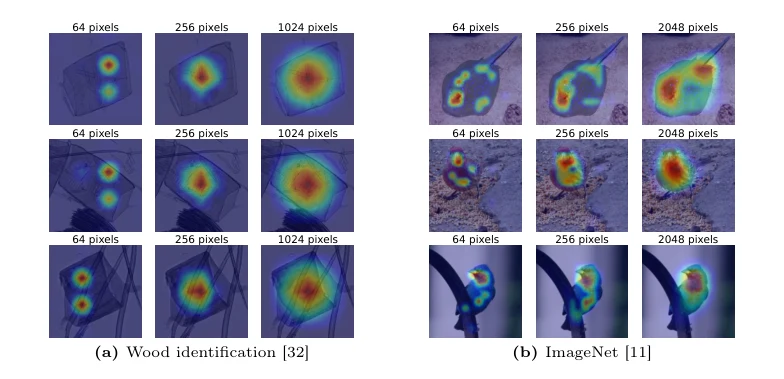
A classifier can get the right answer for the wrong reason by relying on the background around an object. Top-GAP encourages it to concentrate on a smaller, informative region. That makes its decisions easier to locate in the image and can reduce dependence on misleading surroundings.
Abstract
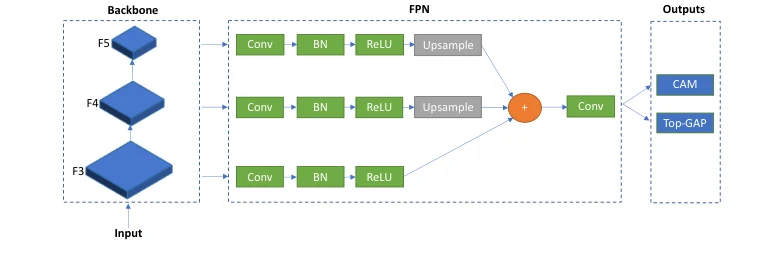
This paper introduces Top-GAP, a novel regularization technique that enhances the explainability and robustness of convolutional neural networks. By constraining the spatial size of the learned feature representation, our method forces the network to focus on the most salient image regions, effectively reducing background influence. Using adversarial attacks and the Effective Receptive Field, we show that Top-GAP directs more attention towards object pixels rather than the background. This leads to enhanced interpretability and robustness. We achieve over 50% robust accuracy on CIFAR-10 with PGD ε = 8/255 and 20 iterations while maintaining the original clean accuracy. Furthermore, we see increases of up to 5% accuracy against distribution shifts. Our approach also yields more precise object localization, as evidenced by up to 25% improvement in Intersection over Union (IOU) compared to methods like GradCAM and Recipro-CAM.
Figures
Cite this paper
@inproceedings{nieradzik2024topgapintegrating39,
  title = {{Top-GAP - Integrating Size Priors in CNNs for more Interpretability, Robustness, and Bias Mitigation}},
  author = {Lars Nieradzik and Henrike Stephani and Janis Keuper},
  booktitle = {eCVX Workshop at ECCV 24},
  year = {2024},
  url = {https://arxiv.org/pdf/2409.04819}
}
Figures and abstract are reproduced from the linked research sources. Credit remains with the authors and publishers.