
Synthetic Data for Computer Vision Workshop@ CVPR 2025 · 2025
Corner Cases - How Size and Position of Objects Challenge ImageNet-Trained Models
Why this publication matters
Moving an object toward the edge of a photo should not change what it is. This work shows how object size and position can instead make classifiers rely more on the background. Its challenging examples reveal failures that standard, well-framed benchmark images may overlook.
Abstract
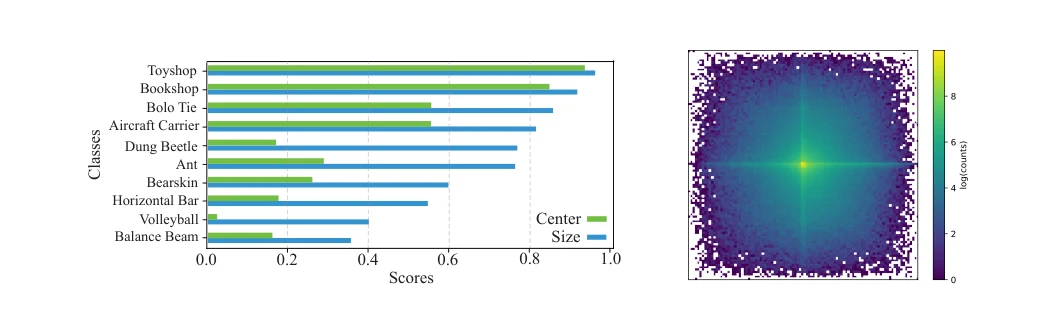
Backgrounds in images play a major role in contributing to spurious correlations among different data points. Owing to aesthetic preferences of humans capturing the images, datasets can exhibit positional (location of the object within a given frame) and size (region-of-interest to image ratio) biases for different classes. In this paper, we show that these biases can impact how much a model relies on spurious features in the background to make its predictions. To better illustrate our findings, we propose a synthetic dataset derived from ImageNet-1k, Hard-Spurious-ImageNet, which contains images with various backgrounds, object positions, and object sizes. By evaluating the dataset on different pretrained models, we find that most models rely heavily on spurious features in the background when the region-of-interest (ROI) to image ratio is small and the object is far from the center of the image. Moreover, we also show that current methods that aim to mitigate harmful spurious features, do not take into account these factors, hence fail to achieve considerable performance gains for worst-group accuracies when the size and location of core features in an image change. The dataset and implementation code are available at https://github.com/Mishalfatima/Corner_Cases.
Figures

Cite this paper
@inproceedings{fatima2025cornercaseshow61,
  title = {{Corner Cases - How Size and Position of Objects Challenge ImageNet-Trained Models}},
  author = {M. Fatima and S. Jung and M. Keuper},
  booktitle = {Synthetic Data for Computer Vision Workshop@ CVPR 2025},
  year = {2025},
  url = {https://openreview.net/forum?id=B6l94JAyKr}
}
Figures and abstract are reproduced from the linked research sources. Credit remains with the authors and publishers.