
Proceedings of the IEEE/CVF Conference on Computer Vision and Pattern Recognition Workshops (CVPRw 2025) · 2025
3D-WAG - Wavelet-Guided Autoregressive Generation for 3D Shapes
Why this publication matters
Generating detailed 3D objects can require very long sequences of predictions. This method organizes shape information from coarse structure to fine detail using wavelets. That reduces the burden of generation while preserving a route to rich, realistic geometry.
Abstract
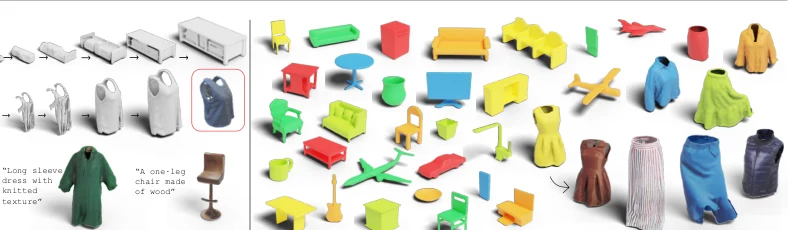
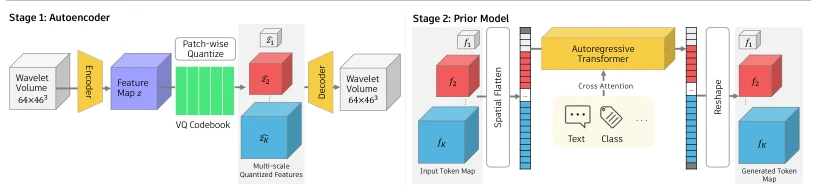
Autoregressive (AR) models excel in language and image generation, but their role in 3D generation faces high computational cost and resolution challenges. Existing 3D AR methods, using voxel grids or implicit representations, produce long, redundant token sequences, limiting high-fidelity 3D shape generation and incurring high inference cost. To address these issues, we introduce 3D-WAG, a novel autoregressive framework employing compact wavelet-based hierarchical representations for efficient and expressive 3D shape generation. By representing the shapes in the wavelet domain, 3D-WAG captures coarse to fine geometric details as multi-scale discrete token maps, using a 3D vector-quantized variational autoencoder (VQVAE), enabling efficient AR modeling and detailed shape understanding. Unlike conventional next-token prediction, 3D-WAG formulates 3D shape generation as a next-scale token map prediction problem, achieving a faster inference time of 1.15 seconds per sample on a single NVIDIA H100 GPU, which is 15 times faster than the state-of-the-art diffusion-based 3D generation model UDiFF. Furthermore, 3D-WAG supports unconditional, class-conditional, and text-conditional shape generation. Experimental results on standard 3D benchmarks, including ShapeNet and DeepFashion3D, show that 3D-WAG outperforms state-of-the-art methods on metrics such as Minimum Matching Distance (MMD) and Coverage (COV), generating highquality 3D shapes that accurately represent real-world data distributions.
Figures
Cite this paper
@inproceedings{medi20253dwagwavelet64,
  title = {{3D-WAG - Wavelet-Guided Autoregressive Generation for 3D Shapes}},
  author = {Tejaswini Medi and Arianna Rampini and Pradyumna Reddy and Pradeep Kumar Jayaraman and Margret Keuper},
  booktitle = {Proceedings of the IEEE/CVF Conference on Computer Vision and Pattern Recognition Workshops (CVPRw 2025)},
  year = {2025},
  url = {https://arxiv.org/abs/2411.19037}
}
Figures and abstract are reproduced from the linked research sources. Credit remains with the authors and publishers.