
Synthetic Data for Computer Vision Workshop@ CVPR 2025 · 2025
DispBench - Benchmarking Disparity Estimation to Synthetic Corruptions
Why this publication matters
Estimating depth from two cameras is useful only if it remains dependable when the images deteriorate. DispBench puts stereo models through a common collection of corruption and attack tests. It makes weaknesses and trade-offs easier to compare before relying on depth estimates in changing conditions.
Abstract
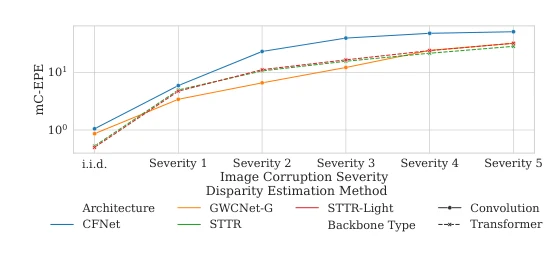
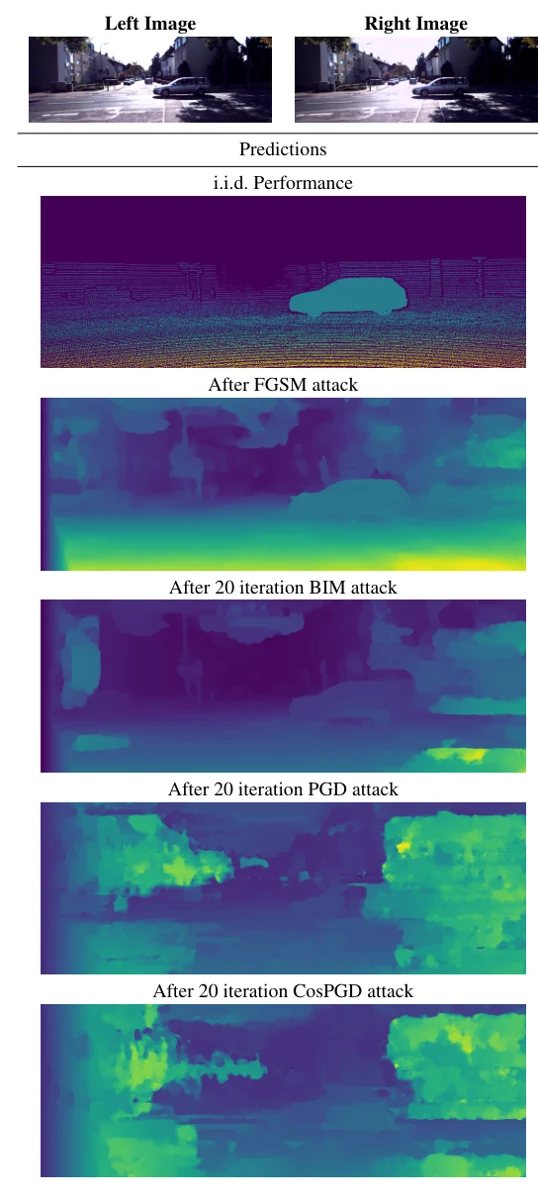
Deep learning (DL) has surpassed human performance on standard benchmarks, driving its widespread adoption in computer vision tasks. One such task is disparity estimation, estimating the disparity between matching pixels in stereo image pairs, which is crucial for safety-critical applications like medical surgeries and autonomous navigation. However, DL-based disparity estimation methods are highly susceptible to distribution shifts and adversarial attacks, raising concerns about their reliability and generalization. Despite these concerns, a standardized benchmark for evaluating the robustness of disparity estimation methods remains absent, hindering progress in the field. To address this gap, we introduce DISPBENCH, a comprehensive benchmarking tool for systematically assessing the reliability of disparity estimation methods. DISPBENCH evaluates robustness against synthetic image corruptions such as adversarial attacks and out-of-distribution shifts caused by 2D Common Corruptions across multiple datasets and diverse corruption scenarios. We conduct the most extensive performance and robustness analysis of disparity estimation methods to date, uncovering key correlations between accuracy, reliability, and generalization. Open-source code for DISPBENCH.
Figures
Cite this paper
@inproceedings{agnihotri2025dispbenchbenchmarkingdisparity60,
  title = {{DispBench - Benchmarking Disparity Estimation to Synthetic Corruptions}},
  author = {S. Agnihotri and A. Ansari and A. Dackermann and F. Rösch and M. Keuper},
  booktitle = {Synthetic Data for Computer Vision Workshop@ CVPR 2025},
  year = {2025},
  url = {https://openreview.net/forum?id=yIEInigSp9}
}
Figures and abstract are reproduced from the linked research sources. Credit remains with the authors and publishers.