
Transactions on Machine Learning Research (TMLR) · 2025
FlowBench - Benchmarking Optical Flow Estimation Methods for Reliability and Generalization
Why this publication matters
Optical flow estimates how things move between images, making reliability as important as clean benchmark accuracy. FlowBench evaluates models under a shared set of attacks and changed conditions. It helps identify whether newer methods are becoming more dependable as well as more accurate.
Abstract
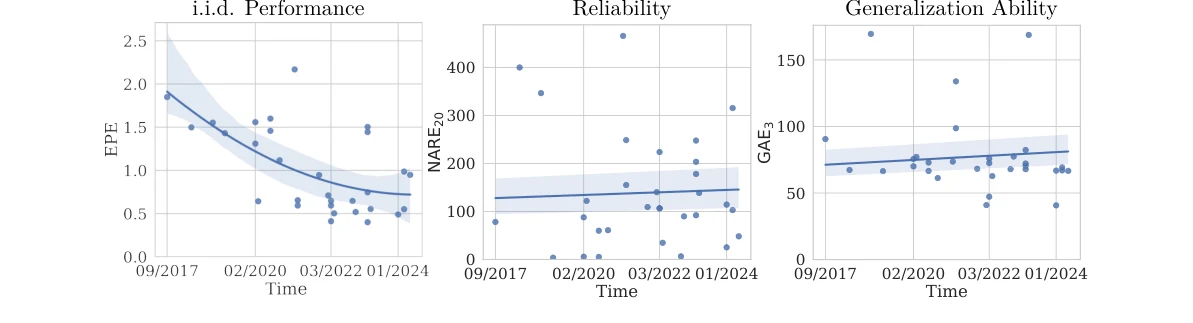
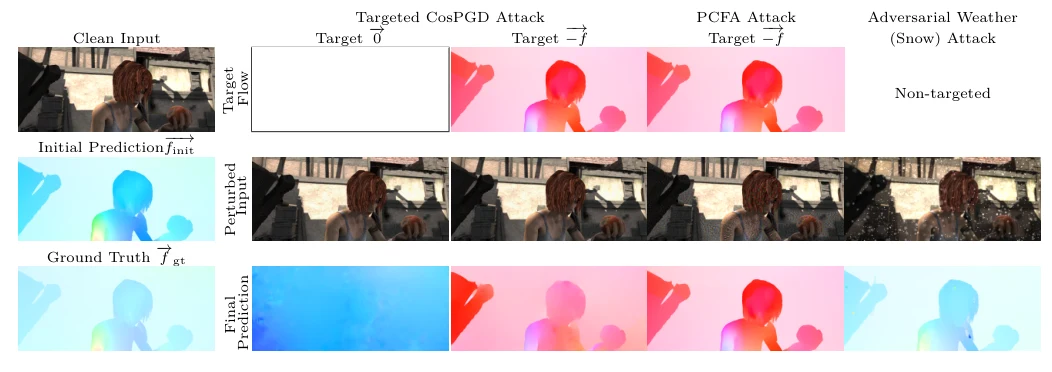
Optical flow estimation is a crucial computer vision task often applied to safety-critical real-world scenarios like autonomous driving and medical imaging. While optical flow estimation accuracy has greatly benefited from the emergence of deep learning, learning-based methods are also known for their lack of generalization and reliability. However, reliability is paramount when optical flow methods are employed in the real world, where safety is essential. Furthermore, a deeper understanding of the robustness and reliability of learningbased optical flow estimation methods is still lacking, hindering the research community from building methods safe for real-world deployment. Thus, we propose FlowBench, a robustness benchmark and evaluation tool for learning-based optical flow methods. FlowBench facilitates streamlined research into the reliability of optical flow methods by benchmarking their robustness to adversarial attacks and out-of-distribution samples. With FlowBench, we benchmark 57 checkpoints across 3 datasets under 9 diverse adversarial attacks and 23 established common corruptions, making it the most comprehensive robustness analysis of optical flow methods to date. Across this wide range of methods, we consistently find that methods with state-of-the-art performance on established standard benchmarks lack reliability and generalization ability. Moreover, we find interesting correlations between the performance, reliability, and generalization ability of optical flow estimation methods, under various lenses such as design choices used, number of parameters, etc. The open-source code and weights for FlowBench are available in this GitHub repository.
Figures
Cite this paper
@article{agnihotri2025flowbenchbenchmarkingoptical69,
  title = {{FlowBench - Benchmarking Optical Flow Estimation Methods for Reliability and Generalization}},
  author = {Shashank Agnihotri and Julian Yuya Caspary and Luca Schwarz and Xinyan Gao and Jenny Schmalfuss and Andrés Bruhn and Margret Keuper},
  journal = {Transactions on Machine Learning Research},
  year = {2025},
  url = {https://openreview.net/forum?id=Kh4bj6YDNm}
}
Figures and abstract are reproduced from the linked research sources. Credit remains with the authors and publishers.