
Transactions on Machine Learning Research (TMLR) · 2026
RAWDet-7 A Multi-Scenario Benchmark for Object Detection and Description on Quantized RAW Images
Why this publication matters
Camera processing is usually designed to make pictures pleasant for people, but machines may need different information. RAWDet-7 tests recognition and description directly on sensor data with different levels of numerical precision. It provides evidence for studying the trade-off between data efficiency and useful visual information.
Abstract
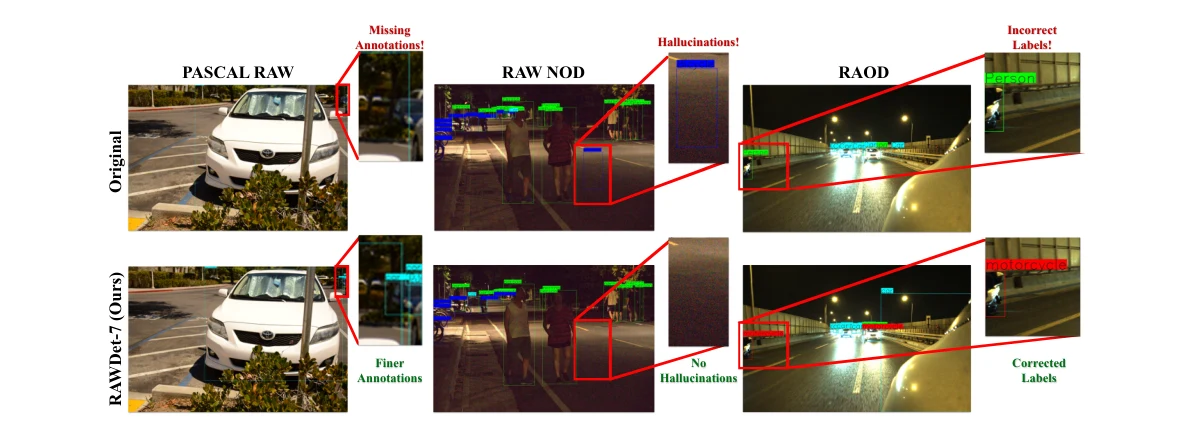
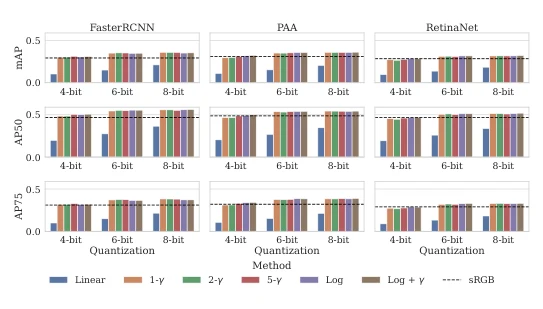
Most vision models are trained on RGB images processed through ISP pipelines optimized for human perception, which can discard sensor-level information useful for machine reasoning. RAW images preserve unprocessed scene data, enabling models to leverage richer cues for both object detection and object description, capturing finegrained details, spatial relationships, and contextual information often lost in processed images. To support research in this domain, we introduce RAWDET-7, a large-scale dataset of ∼25k training and 7.6k test RAW images collected across diverse cameras, lighting conditions, and environments, densely annotated for seven object categories following MS-COCO and LVIS conventions. In addition, we provide object-level descriptions derived from the corresponding high-resolution sRGB images, facilitating the study of object-level information preservation under RAW image processing and low-bit quantization. The dataset allows evaluation under simulated 4-bit, 6-bit, and 8-bit quantization, reflecting realistic sensor constraints, and provides a benchmark for studying detection performance, description quality & detail, and generalization in low-bit RAW image processing. Dataset & code upon acceptance.
Figures
Cite this paper
@article{fatima2026rawdet7a90,
  title = {{RAWDet-7 A Multi-Scenario Benchmark for Object Detection and Description on Quantized RAW Images}},
  author = {M. Fatima and S. Agnihotri and K. V. Gandikota and M. Moeller and Margret Keuper},
  journal = {Transactions on Machine Learning Research},
  year = {2026},
  url = {https://openreview.net/forum?id=UHTJrsYieo}
}
Figures and abstract are reproduced from the linked research sources. Credit remains with the authors and publishers.