
IEEE Transactions on Pattern Analysis and Machine Intelligence (TPAMI) · 2026
Examining the Impact of Optical Aberrations to Image Classification and Object Detection Models
Why this publication matters
Blur from real optics is more complicated than a generic smoothing filter. This work tests classification and detection models with camera-inspired aberrations to expose differences that simpler tests miss. It helps connect model evaluation to the physical imaging system supplying the data.
Abstract
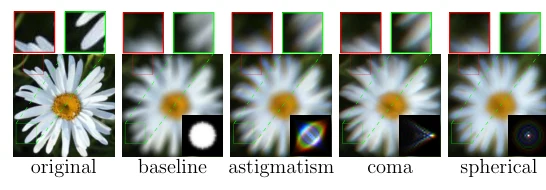
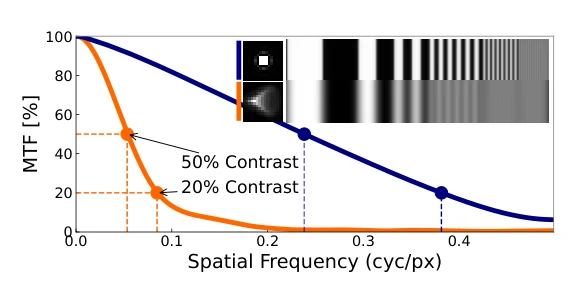
Deep neural networks (DNNs) have proven to be successful in various computer vision applications such that models even infer in safety-critical situations. Therefore, vision models have to behave in a robust way to disturbances such as noise or blur. While seminal benchmarks exist to evaluate model robustness to diverse corruptions, blur is often approximated in an overly simplistic way to model defocus, while ignoring the different blur kernel shapes that result from optical systems. To study model robustness against realistic optical blur effects, this paper proposes two datasets of blur corruptions, which we denote OpticsBench and LensCorruptions. OpticsBench examines primary aberrations such as coma, defocus, and astigmatism, i.e. aberrations that can be represented by varying a single parameter of Zernike polynomials. To go beyond the principled but synthetic setting of primary aberrations, LensCorruptions samples linear combinations in the vector space spanned by Zernike polynomials, corresponding to 100 real lenses. Evaluations for image classification and object detection on ImageNet and MSCOCO show that for a variety of different pre-trained models, the performance on OpticsBench and LensCorruptions varies significantly, indicating the need to consider realistic image corruptions to evaluate a model’s robustness against blur.
Figures
Cite this paper
@article{muller2026examiningtheimpact88,
  title = {{Examining the Impact of Optical Aberrations to Image Classification and Object Detection Models}},
  author = {Patrick Müller and Alexander Braun and Margret Keuper},
  journal = {IEEE Transactions on Pattern Analysis and Machine Intelligence},
  year = {2026},
  url = {https://www.computer.org/csdl/journal/tp/2026/03/11205303/2aRi0yIwjS}
}
Figures and abstract are reproduced from the linked research sources. Credit remains with the authors and publishers.