
Proceedings of the IEEE/CVF International Conference on Computer Vision Workshops (ICCVw 2025) · 2025
Vision At Night - Exploring Biologically Inspired Preprocessing For Improved Robustness Via Color And Contrast Transformations
Why this publication matters
Darkness changes the information available to a camera, while many vision models are trained mainly on ordinary color photographs. This work explores simple transformations inspired by how biological vision handles color and contrast. It shows that changing the representation of the input can improve robustness without making the learned model more complicated.
Abstract
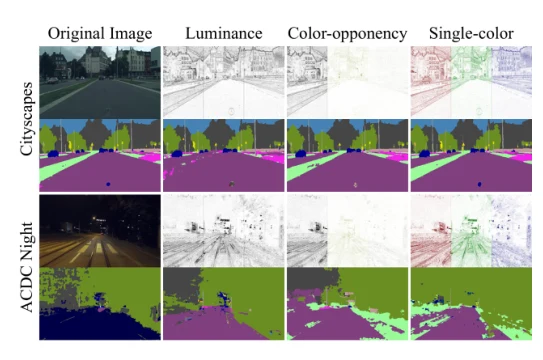
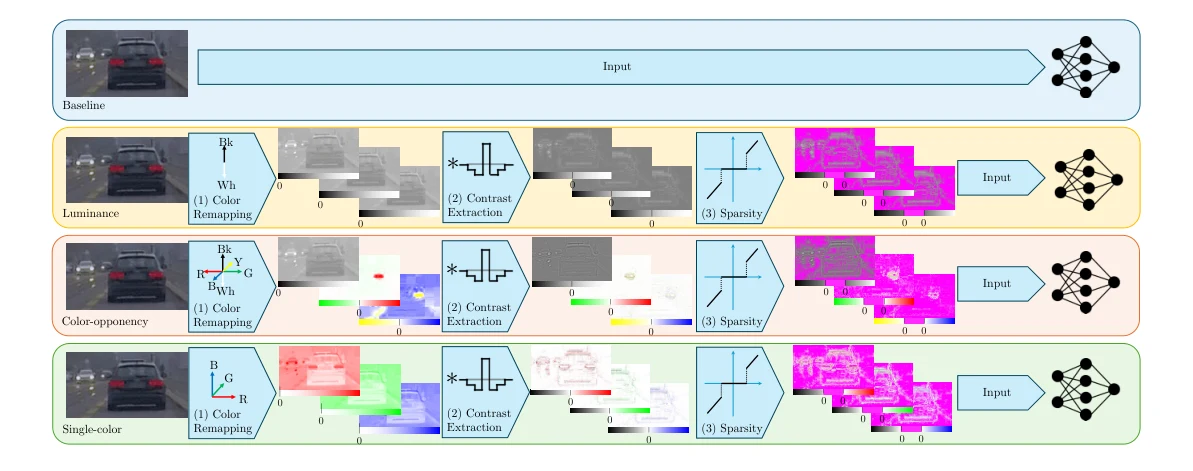
Deep neural networks surpass humans on many vision benchmarks, yet remain far less robust to distribution shifts such as illumination and weather changes. Existing approaches address this challenge by additional training data, extensive augmentation, architectural modifications, or test-time adaptation. In this work, we explore a complementary direction: inspired by the human retina, we propose a fixed, model-agnostic preprocessing module that extracts signals that are more stable with respect to variations of illumination. Our method combines color remapping with local contrast extraction, producing sparse representations that emphasize structural features. We study its impact on semantic segmentation by training on Cityscapes and evaluating generalization under adverse conditions on Dark Zurich and ACDC. Our results show that the biologically inspired preprocessing preserves in-distribution performance while consistently improving robustness in challenging lighting scenarios, such as nighttime, where annotated training data are scarce. Moreover, the segmentation accuracy remains stable even when the contrast-based representation is sparsified by up to 70%. These gains suggest that rethinking the input representation itself can improve robustness while also opening opportunities for lower-latency, transmission-aware imaging sensors when sparsity can be exploited close to acquisition.
Figures
Cite this paper
@inproceedings{stracke2025visionatnight72,
  title = {{Vision At Night - Exploring Biologically Inspired Preprocessing For Improved Robustness Via Color And Contrast Transformations}},
  author = {Lorena Stracke and Lia Nimmermann and Shashank Agnihotri and Margret Keuper and Volker Blanz},
  booktitle = {Proceedings of the IEEE/CVF International Conference on Computer Vision Workshops (ICCVw 2025)},
  year = {2025},
  url = {https://arxiv.org/pdf/2509.24863}
}
Figures and abstract are reproduced from the linked research sources. Credit remains with the authors and publishers.