
Geophysical Prospecting · 2020
Detection of point scatterers using diffraction imaging and deep learning
Why this publication matters
Small geological features can leave faint signals that are overwhelmed by stronger reflections. This work teaches a model to recognize those signals using simulated examples, then tests it on field recordings. It offers a way to make otherwise hard-to-see underground structures easier to locate.
Abstract
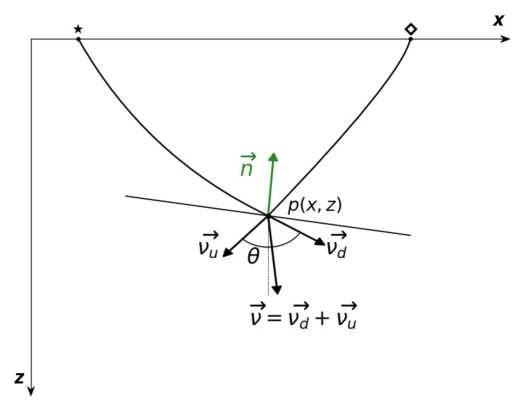
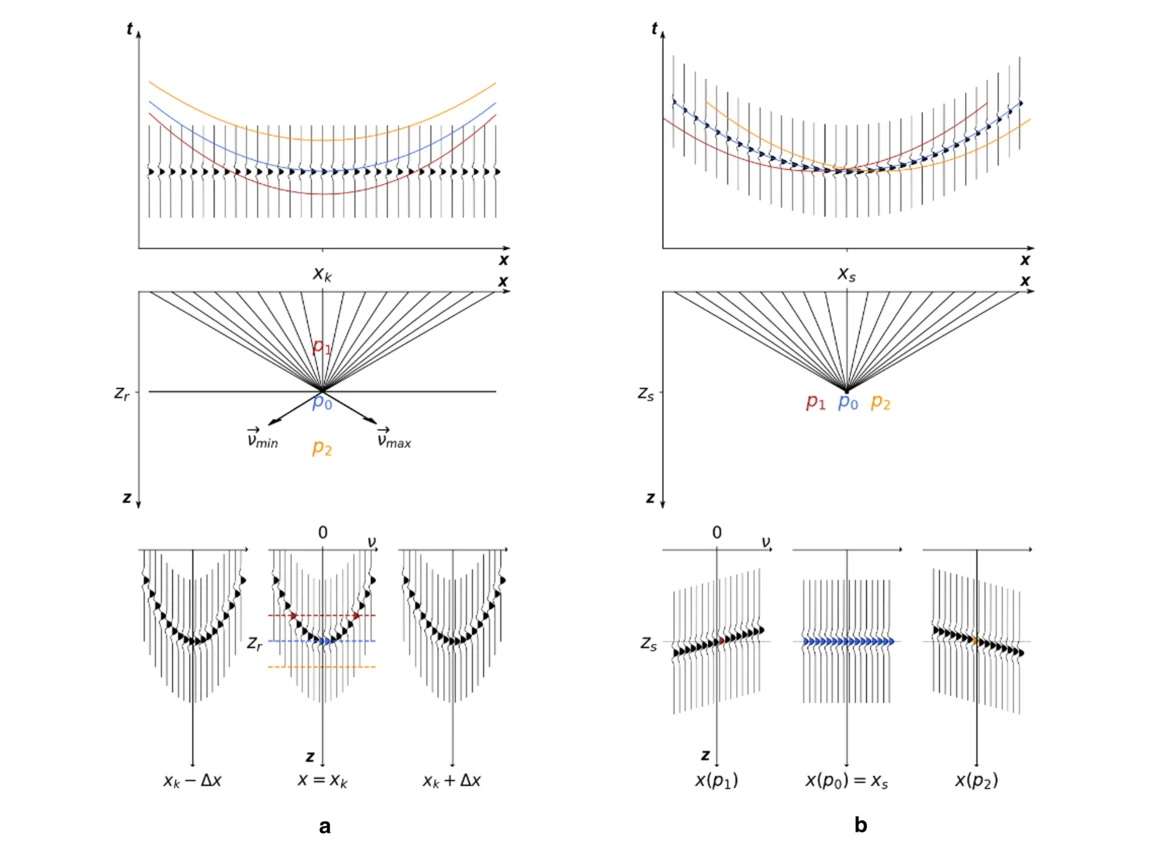
Diffracted waves carry high-resolution information that can help interpreting fine structural details at a scale smaller than the seismic wavelength. However, the diffraction energy tends to be weak compared to the reflected energy and is also sensitive to inaccuracies in the migration velocity, making the identification of its signal challenging. In this work, we present an innovative workflow to automatically detect scattering points in the migration dip angle domain using deep learning. By taking advantage of the different kinematic properties of reflected and diffracted waves, we separate the two types of signals by migrating the seismic amplitudes to dip angle gathers using prestack depth imaging in the local angle domain. Convolutional neural networks are a class of deep learning algorithms able to learn to extract spatial information about the data in order to identify its characteristics. They have now become the method of choice to solve supervised pattern recognition problems. In this work, we use wave equation modelling to create a large and diversified dataset of synthetic examples to train a network into identifying the probable position of scattering objects in the subsurface. After giving an intuitive introduction to diffraction imaging and deep learning and discussing some of the pitfalls of the methods, we evaluate the trained network on field data and demonstrate the validity and good generalization performance of our algorithm. We successfully identify with a high-accuracy and high-resolution diffraction points, including those which have a low signal to noise and reflection ratio. We also show how our method allows us to quickly scan through high dimensional data consisting of several versions of a dataset migrated with a range of velocities to overcome the strong effect of incorrect migration velocity on the diffraction signal.
Figures
Cite this paper
@article{tschannen2020detectionofpoint3,
  title = {{Detection of point scatterers using diffraction imaging and deep learning}},
  author = {Valentin Tschannen and Matthias Delescluse and Norman Ettrich and Janis Keuper},
  journal = {Geophysical Prospecting},
  year = {2020},
  url = {https://www.earthdoc.org/content/journals/10.1111/1365-2478.12889?crawler=true&mimetype=application/pdf},
  doi = {10.1111/1365-2478.12889}
}
Figures and abstract are reproduced from the linked research sources. Credit remains with the authors and publishers.