
Geophysics - Journal of the Society of Exploration Geophysicists and American Association of Petroleum Geologists · 2023
An In-Depth Study of U-net for Seismic Data Conditioning - Multiple Removal by Move-Out Discrimination
Why this publication matters
Repeated seismic reflections can hide the underground structures an interpreter wants to see. This study trains a neural network to remove them using synthetic examples and examines how its settings and uncertainty affect the results. The detailed analysis helps practitioners judge the method rather than treating it as an unexplained black box.
Abstract
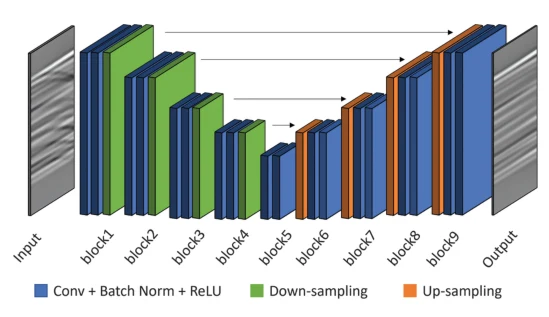
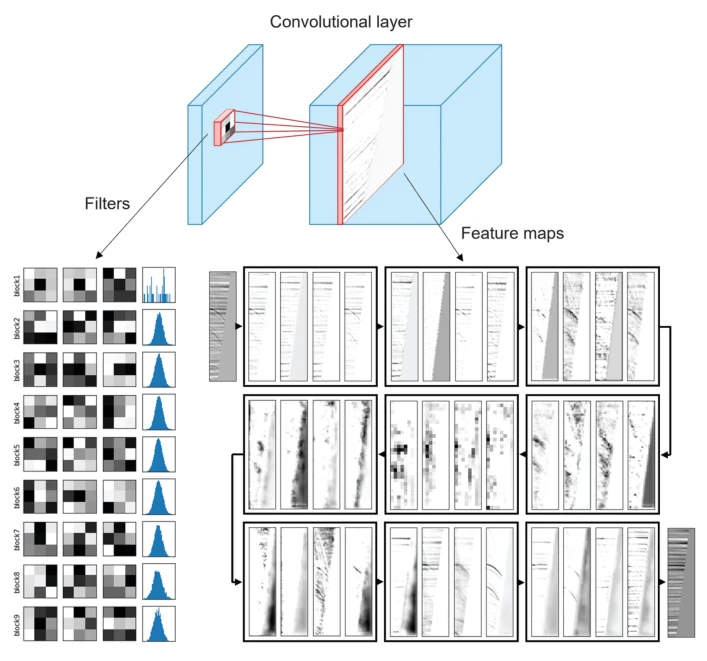
Seismic processing often involves suppressing multiples that are an inherent component of collected seismic data. Elaborate multiple prediction and subtraction schemes such as surface-related multiple removal have become standard in industry workflows. In cases of limited spatial sampling, low signal-to-noise ratio, or conservative subtraction of the predicted multiples, the processed data frequently suffer from residual multiples. To tackle these artifacts in the postmigration domain, practitioners often rely on Radon transformbased algorithms. However, such traditional approaches are both time-consuming and parameter dependent, making them relatively complex. In this work, we present a deep learning-based alternative that provides competitive results, while reducing the complexity of its usage, and, hence simplifying its applicability. Our proposed model demonstrates excellent performance when applied to complex field data, despite it being exclusively trained on synthetic data. Furthermore, extensive experiments show that our method can preserve the inherent characteristics of the data, avoiding undesired oversmoothed results, while removing the multiples from seismic offset or angle gathers. Finally, we conduct an in-depth analysis of the model, where we pinpoint the effects of the main hyperparameters on real data inference, and we probabilistically assess its performance from a Bayesian perspective. In this study, we put particular emphasis on helping the user reveal the inner workings of the neural network and attempt to unbox the model.
Figures
Cite this paper
@article{durall2023anindepth34,
  title = {{An In-Depth Study of U-net for Seismic Data Conditioning - Multiple Removal by Move-Out Discrimination}},
  author = {Ricard Durall and Ammar Ghanim and Norman Ettrich and Janis Keuper},
  journal = {Geophysics},
  year = {2023},
  url = {https://library.seg.org/doi/pdf/10.1190/geo2023-0146.1},
  doi = {10.1190/geo2023-0146.1}
}
Figures and abstract are reproduced from the linked research sources. Credit remains with the authors and publishers.