
NeurIPS 2022 Workshop on Distribution Shifts - Connecting Methods and Applications · 2022
Impact of realistic properties of the point spread function on classification tasks to reveal a possible distribution shift
Why this publication matters
A real camera lens blurs different colors and directions in different ways. This paper shows that those effects can change a classifier's behavior in ways that standard blur tests miss. More realistic optical tests can help researchers understand how a model will respond to the camera that supplies its images.
Abstract
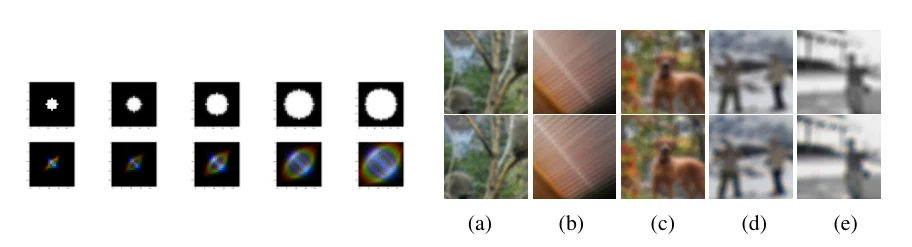
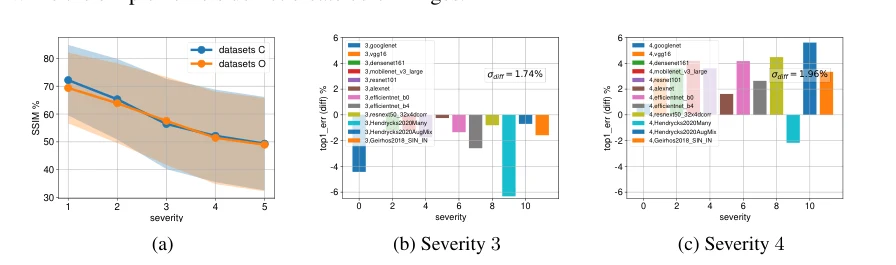
Image classification is a long-standing task in computer vision with deep neural networks (DNN) producing excellent results on various challenges. However, they are required not only to perform highly accurate on benchmarks such as ImageNet, but also to robustly handle images in adverse conditions, such as modified lighting, sharpness, weather conditions and image compression. Various benchmarks aimed to measure robustness show that neural networks perform differently well under distribution shifts. While datasets such as ImageNet-C model for example common corruptions such as blur and adverse weather conditions, we argue that the properties of the optical system and the potentially resulting complex lens blur are insufficiently well studied in the literature. This study evaluates the impact of realistic optical corruptions on the ImageNet classification. The proposed complex corruption kernels are direction and wavelength dependent and include chromatic aberration, which are all to be expected in realistic scenarios such as autonomous driving applications. Our experiments on twelve different DNN models show significant differences of more than 5% in the top1 classification error, when compared to the model performances on matched ImageNet-C blur kernels.
Figures
Cite this paper
@inproceedings{muller2022impactofrealistic21,
  title = {{Impact of realistic properties of the point spread function on classification tasks to reveal a possible distribution shift}},
  author = {Patrick Müller and Alexander Braun and Margret Keuper},
  booktitle = {NeurIPS 2022 Workshop on Distribution Shifts - Connecting Methods and Applications},
  year = {2022},
  url = {https://pure.mpg.de/rest/items/item_3473172/component/file_3473173/content}
}
Figures and abstract are reproduced from the linked research sources. Credit remains with the authors and publishers.