
Transactions on Machine Learning Research (TMLR) · 2024
Learning the essential in less than 2k additional weights - a simple approach to improve image classification stability under corruptions
Why this publication matters
A small addition to the input pipeline can make an existing classifier more stable under image corruption. This work learns that addition using fewer than 2,000 extra weights. It demonstrates that improving reliability can sometimes begin with a lightweight preprocessing step rather than a larger network.
Abstract
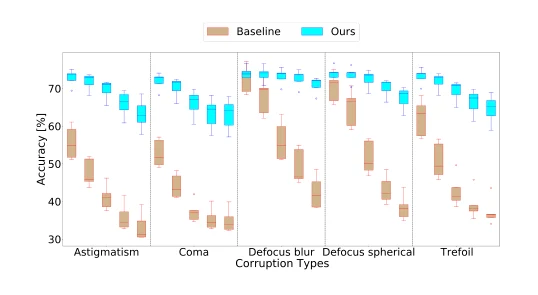
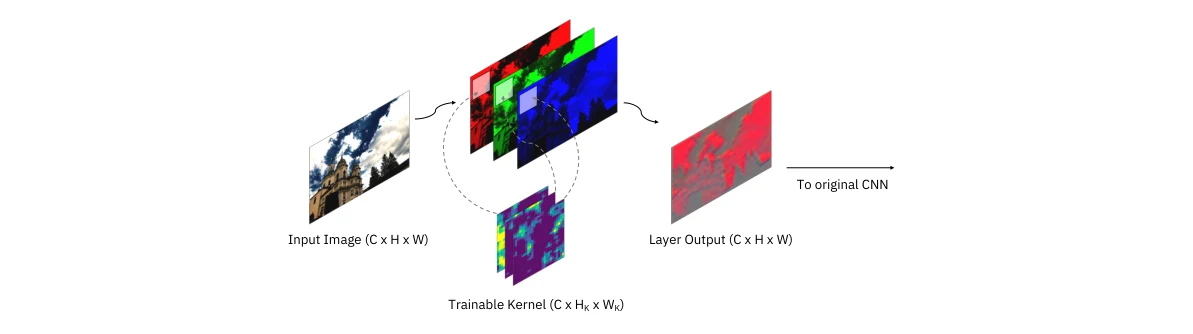
The performance of image classification on well-known benchmarks such as ImageNet is remarkable, but in safety-critical situations, the accuracy often drops significantly under adverse conditions. To counteract these performance drops, we propose a very simple modification to the models: we pre-pend a single, dimension preserving convolutional layer with a large linear kernel whose purpose it is to extract the information that is essential for image classification. We show that our simple modification can increase the robustness against common corruptions significantly, especially for corruptions of high severity. We demonstrate the impact of our channel-specific layers on ImageNet-100 and ImageNette classification tasks and show an increase of up to 30% accuracy on corrupted data in the top1 accuracy. Further, we conduct a set of designed experiments to qualify the conditions for our findings. Our main result is that a data- and network-dependent linear subspace carries the most important classification information (the essential), which our proposed pre-processing layer approximately identifies for most corruptions, and at very low cost.
Figures
Cite this paper
@article{bauerle2024learningtheessential51,
  title = {{Learning the essential in less than 2k additional weights - a simple approach to improve image classification stability under corruptions}},
  author = {Kai Bäuerle and Patrick Müller and Syed Muhammad Kazim and Ivo Ihrke and Margret Keuper},
  journal = {Transactions on Machine Learning Research},
  year = {2024},
  url = {https://openreview.net/pdf?id=i2SuGWtIIm}
}
Figures and abstract are reproduced from the linked research sources. Credit remains with the authors and publishers.