
Transactions on Machine Learning Research (TMLR) · 2026
Parameterized Adverse Lens Corruptions to Probe Model Robustness to Optical Tolerances
Why this publication matters
Small optical imperfections can matter to a vision model even when blur seems harmless to a person. This paper searches for difficult blur patterns using parameters tied to lens aberrations, revealing vulnerabilities that ordinary noise tests do not capture. It gives researchers a way to investigate camera-related weaknesses before relying on a model in changing conditions.
Abstract
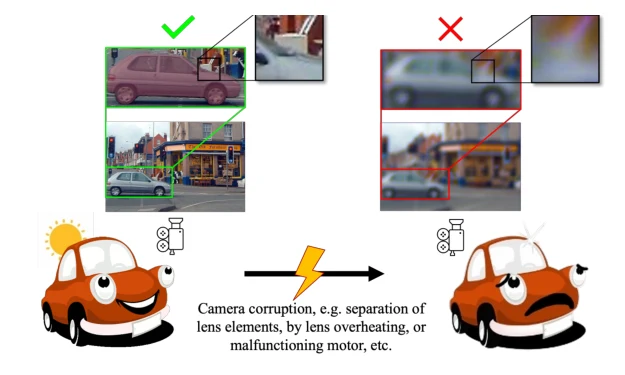
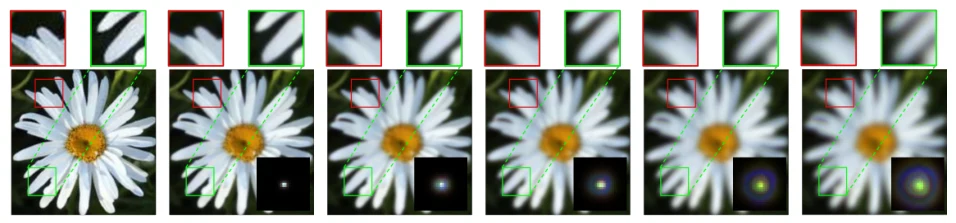
Deep neural networks excel at image classification on benchmarks like ImageNet, yet they remain vulnerable to adverse conditions, including environmental changes and sensor noise, such as lens blur or camera noise. Consequently, the study of these adverse noise corruptions has been extensive. At the same time, image blur, naturally introduced in optical systems, has been widely ignored as a threat to model robustness. In fact, Gaussian blur has even been considered as viable defense against adversarial attacks. In this work, we challenge the common perception of blur as a rather benign data corruption and study optics-driven, blur-based adversarial attacks. Specifically, we introduce Adverse Lens Corruption (ALC), an optics-driven robustness probe that, through adversarial optimization, identifies worst-case lens blurs by optimizing Zernike polynomial-based aberrations. Unlike traditional noise-based attacks, ALC provides a physically-motivated continuous search space. This enables the analysis of model robustness to optics-driven blur corruptions and complements existing noise and corruption benchmarks.
Figures
Cite this paper
@article{bauerle2026parameterizedadverselens89,
  title = {{Parameterized Adverse Lens Corruptions to Probe Model Robustness to Optical Tolerances}},
  author = {Kai Bäuerle and Patrick Müller and Ivo Ihrke and Margret Keuper},
  journal = {Transactions on Machine Learning Research},
  year = {2026},
  url = {https://openreview.net/pdf?id=a93BmQRNxC}
}
Figures and abstract are reproduced from the linked research sources. Credit remains with the authors and publishers.