
NeurIPS 2026 (accepted; arXiv preprint) · 2026
2D Spatial Reasoning with Adaptive Neural Cellular Automata
Why this publication matters
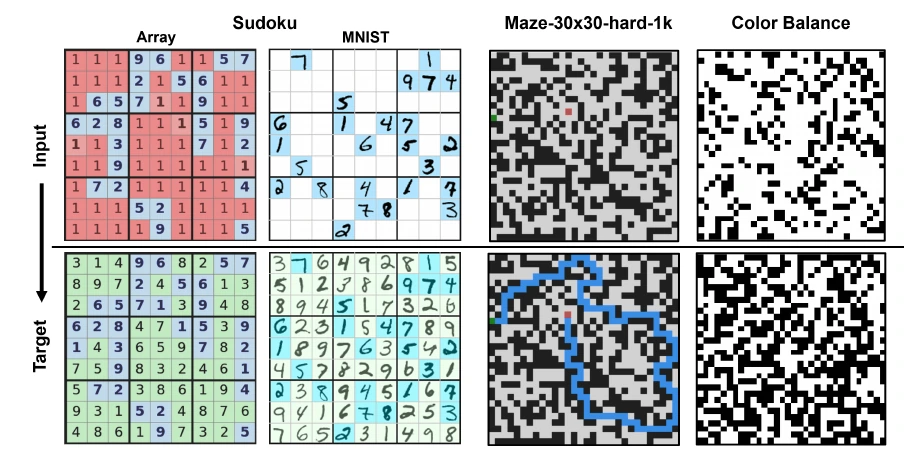
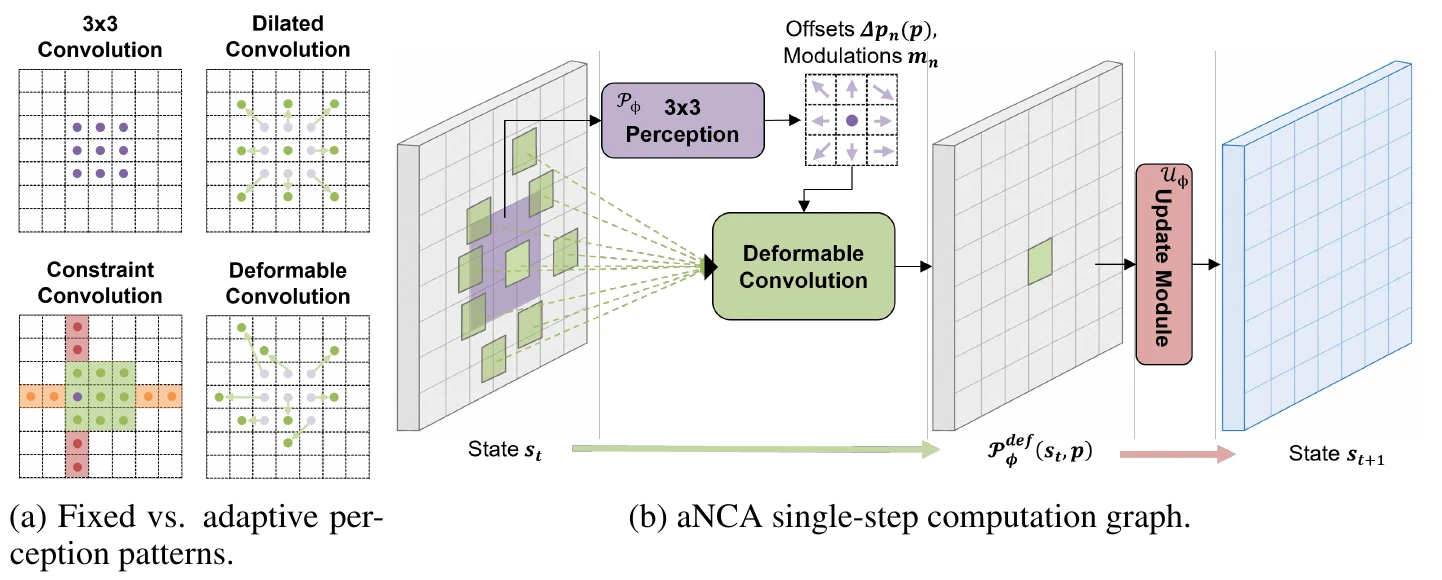
Solving a Sudoku or tracing a path through a maze requires local decisions to respect relationships across an entire grid. This paper gives neural cellular automata adaptive perception, allowing each cell to learn which other locations matter at each iteration. The resulting compact models tackle several controlled spatial reasoning benchmarks, while visualizing their learned sampling locations helps reveal the relationships they use. These experiments provide task-specific evidence about spatial reasoning on 2D grids.
Abstract
Many modern learning approaches are still struggling with spatial reasoning tasks, i.e. they lack the ability to utilize geometric information of perceived entities and their spatial relation to each other to solve problems. We introduce a novel Adaptive Neural Cellular Automata (aNCA) architecture which replaces the static and spatially invariant perception of standard NCAs by learnable, spatially variant and data-adaptive perceptive fields. We show that this conceptual change enables NCAs to iteratively reason over 2D spatial relations on grid-like data structures (e.g. images). Empirical results on public benchmarks show state of the art comprehensible results with high generalization abilities for solving image based puzzles like Sudoku or finding the shortest path in a maze. The implementation and all experimental setups are openly accessible as an extension to the NCAtorch framework at https://github.com/mspitzna/NCAtorch.
Figures
Cite this paper
@misc{spitznagel20262dspatialreasoningadaptive,
  title = {2D Spatial Reasoning with Adaptive Neural Cellular Automata},
  author = {Martin Spitznagel and Janis Keuper},
  year = {2026},
  eprint = {2610.08518},
  archivePrefix = {arXiv},
  primaryClass = {cs.CV},
  url = {https://arxiv.org/abs/2610.08518}
}
Figures and abstract are reproduced from the linked research sources. Credit remains with the authors and publishers.