Transactions on Machine Learning Research (TMLR) · 2026
A New Kind of Network? Review and Reference Implementation of Neural Cellular Automata
Why this publication matters
Complex patterns can emerge when many simple units repeatedly follow local rules. This review explains how neural cellular automata learn such rules and provides a shared software framework for experimenting with them. The combination makes a less conventional model family easier to understand, reproduce, and extend.
Abstract
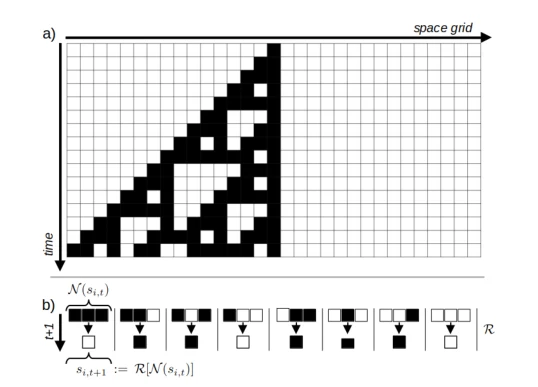
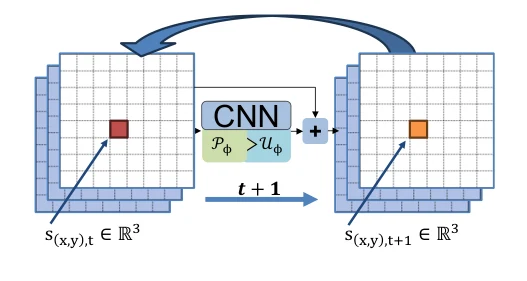
Stephen Wolfram proclaimed in his 2003 seminal work “A New Kind Of Science” that simple recursive programs in the form of Cellular Automata (CA) are a promising approach to replace currently used mathematical formalizations, e.g. differential equations, to improve the modeling of complex systems. Over two decades later, while Cellular Automata have still been waiting for a substantial breakthrough in scientific applications, recent research showed new and promising approaches which combine Wolfram’s ideas with learnable Artificial Neural Networks: So-called Neural Cellular Automata (NCA) are able to learn the complex update rules of CA from data samples, allowing them to model complex, self-organizing generative systems. The aim of this paper is to review the existing work on NCA and provide a unified modular framework and notation, as well as a reference implementation in the open-source library NCAtorch. Project Website: https://www.neural-cellular-automata.org/ Source Code: https://github.com/mspitzna/NCAtorch
Figures
Cite this paper
@article{spitznagel2026anewkind83,
  title = {{A New Kind of Network? Review and Reference Implementation of Neural Cellular Automata}},
  author = {Martin Spitznagel and Janis Keuper},
  journal = {Transactions on Machine Learning Research},
  year = {2026},
  url = {https://openreview.net/pdf?id=NRwjj0ZLq0}
}
Figures and abstract are reproduced from the linked research sources. Credit remains with the authors and publishers.