
International Journal of Computer Vision (IJCV 2026), Volume 134, Article 461 · 2026
Fix Your Downsampling ASAP! Aliasing and Sinc Artifact Free Pooling in the Fourier Domain
Why this publication matters
Reducing the resolution of CNN feature maps can distort the information a network uses to make predictions. This paper extends alias-free FLC Pooling with ASAP, which also suppresses sinc interpolation artifacts. Experiments on ImageNet-1k, ImageNet-C, and CIFAR show more stable features and improved robustness against corruptions and adversarial attacks, with clean accuracy similar to the baseline models.
Abstract
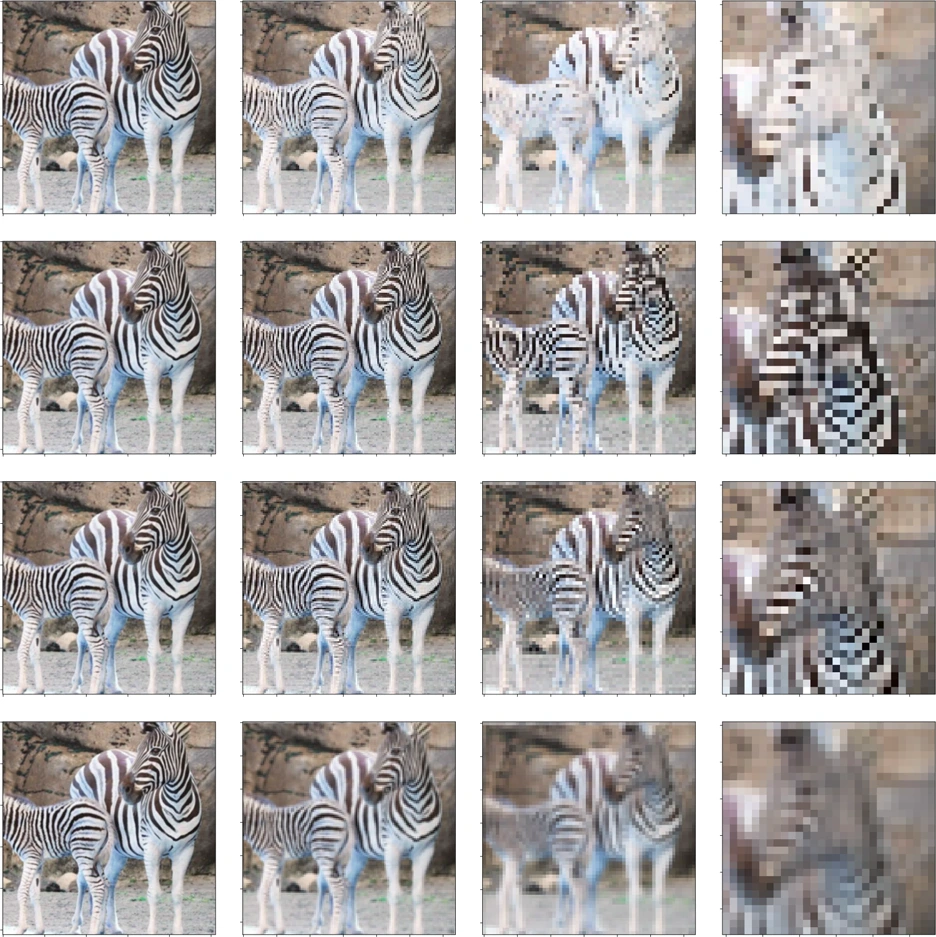
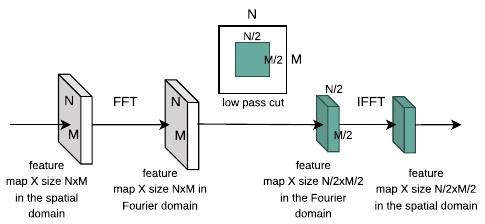
Convolutional Neural Networks (CNNs) are successful in various computer vision tasks. From an image and signal processing point of view, this success is counter-intuitive, as the inherent spatial pyramid design of most CNNs is apparently violating basic signal processing laws, i.e. the Sampling Theorem in their downsampling operations. This issue has been broadly neglected until recent work in the context of adversarial attacks and distribution shifts showed that there is a strong correlation between the vulnerability of CNNs and aliasing artifacts induced by bandlimit-violating downsampling. As a remedy, we propose an alias-free downsampling operation in the frequency domain, denoted Frequency Low Cut Pooling (FLC Pooling) which we further extend to Aliasing and Sinc Artifact-free Pooling (ASAP). ASAP is alias-free and removes further artifacts from sinc-interpolation. Our experimental evaluation on ImageNet-1k, ImageNet-C and CIFAR datasets on various CNN architectures demonstrates that networks using FLC Pooling and ASAP as downsampling methods learn more stable features as measured by their robustness against common corruptions and adversarial attacks, while maintaining a clean accuracy similar to the respective baseline models.
Figures
Cite this paper
@article{grabinski2026asap,
  title = {Fix Your Downsampling ASAP! Aliasing and Sinc Artifact Free Pooling in the Fourier Domain},
  author = {Grabinski, Julia and Jung, Steffen and Keuper, Janis and Keuper, Margret},
  journal = {International Journal of Computer Vision},
  year = {2026},
  volume = {134},
  pages = {461},
  doi = {10.1007/s11263-026-03005-9},
  url = {https://link.springer.com/article/10.1007/s11263-026-03005-9}
}
Figures and abstract are reproduced from the linked research sources. Credit remains with the authors and publishers.